
Socioeconomic Influences on Great Ape Conservation in the Lebialem Highlands, Cameroon
-
Louis Nkembi
Environment and Rural Development Foundation, Buea, Cameroon
Beckline Mukete

Center for Forests and Climate Change, Buea, Cameroon
Agendia NkemndemEnvironment and Rural Development Foundation, Buea, Cameroon
Ajuah VivianEnvironment and Rural Development Foundation, Buea, Cameroon
Mukete NgoeHigher Institute of Agriculture, Wood, Water and the Environment, University of Bertoua, Cameroon
Wang YangEnvironment and Rural Development Foundation, Buea, Cameroon
Fonkwo SylvieDepartment of Zoology, University of Bamenda, Cameroon
Njunkeng NkengafacInstitute of Agricultural Research for Development, Ekona, Cameroon
| Received 30 Jun, 2026 |
Accepted 08 Oct, 2026 |
Published 10 Oct, 2026 |
Background and Objective: The success of wildlife conservation programmes for great apes is largely shaped by how local communities perceive these animals and their readiness to support conservation efforts. This study examines how the knowledge, views, and opinions of local people relate to the protection of chimpanzees and gorillas in the Lebialem Highlands of Southwest Cameroon, and assesses how household socio-demographic characteristics influence these perceptions. Materials and Methods: A mixed-method approach was used, combining household surveys (n = 378) and more than 50 focus group discussions across 32 villages within three conservation zones. In villages with fewer than 25 households, full-coverage surveys were conducted; in larger villages, structured sampling and group discussions were applied. To assess species recognition, respondents were shown laminated photographs of chimpanzees, gorillas, and local monkey species, to confirm they could distinguish great apes from other primates. Questions were designed to evaluate knowledge of species, perceived threats, attitudes, and behaviours during encounters. Data were analysed using SPSS and Pearson Chi-square tests to assess relationships between socio-demographic variables and conservation perceptions (p≤0.05). Results: Age did not significantly affect respondents’ ability to recognise great apes (χ2 = 66.077, P = 0.474), but older respondents demonstrated significantly greater knowledge of threats to great apes (χ2 = 277.718, p<0.001) and were more likely to discuss conservation with their children (χ2 = 81.482, p<0.001). Educational level significantly influenced perceived importance of great apes (χ2 = 156.466, p<0.001). Annual income was significantly linked to reported great ape meat consumption, with lower-income households more likely to consume bushmeat (χ2 = 46.286, p<0.001). Conclusion: Socio-demographic factors, particularly age, income, and education, are significant predictors of conservation-relevant knowledge and attitudes. Effective conservation in the Lebialem Highlands requires targeted education programmes that engage older community members, livelihood diversification to reduce bushmeat dependence among low-income households, and direct great ape conservation.
| Copyright © 2026 Nkembi et al. This is an open-access article distributed under the Creative Commons Attribution License, which permits unrestricted use, distribution, and reproduction in any medium, provided the original work is properly cited. |
INTRODUCTION
In Cameroon, populations of nonhuman great apes (hereafter, great apes), including chimpanzees (Pan troglodytes ellioti), Cross River gorillas (Gorilla gorilla diehli), and Western lowland gorillas (Gorilla gorilla gorilla) are declining. This decline is driven by escalating threats, notably habitat destruction stemming from the expansion of artisanal mining, logging concessions, and forest clearance for agriculture1-7. The acceleration of these anthropogenic activities and the demand for land resources directly exacerbate wildlife exploitation, including hunting for bushmeat.
Over the last two decades, numerous studies have assessed the factors affecting great ape populations across the tropical rainforests of West-Central Africa. For instance8, used participatory rural appraisals to examine the social dimensions of the wildlife trade in Cameroon’s Lebialem division, revealing that over 74% of the trade involved primate hunting. An increase in household income was identified as the primary motivation for hunting. In the northern Democratic Republic of Congo9, documented the sale of numerous chimpanzee orphans and carcasses in areas associated with artisanal mining around the Buta-Bambesa region. Furthermore, researchers10 observed the transformation of formerly pristine great ape habitats into isolated and fragmented forest remnants due to settlement, agroforestry, and agricultural expansion, often confining ape ranges to protected areas.
Beyond these, other studies have linked the decline in great ape populations to various factors including changes in environmental conditions11, infectious diseases12, infrastructural development13, and continued mining, logging, and agricultural expansion14,15. For example, a study by Junker et al.1 reported a consistent decline in great ape numbers in Gabon, where populations were halved between 1983 and 2000 due to Ebola outbreaks and hunting pressure.
Recent studies consistently emphasize that for great ape conservation initiatives to be sustainable, effective, and efficient long-term, researchers and conservation managers must consider the characteristics and socioeconomic needs of local communities. For example16, examined politico-ecological considerations in their study of human-ape relationships in Cameroon’s Mone-Oku Forests. Their research revealed that local communities’ perceptions of great apes depend on factors such as bias, intolerance, and fear. The study also underscored the intricate relationships between humans, gorillas, and chimpanzees specific to each location. It concluded that while generalized or ideal conservation solutions may not exist for the Mone-Oku Forests, initiatives that acknowledge the significance of cocoa farming to local people and integrate diverse insights into cocoa cultivation can foster constructive connections with communities, ultimately supporting threatened primate conservation.
Similarly17, examined human-chimpanzee interactions and local community perceptions concerning biodiversity conservation and wildlife sustainability around Cameroon’s Kimbi-Fungom National Park and Kom-Wum Forest Reserve. Their study revealed that most local inhabitants consumed great ape meat and ritually used ape organs and body parts as medicine during cultural and traditional ceremonies.
Another study by Njukang et al.18 employed participatory rapid appraisals to assess local community attitudes, perceptions, and knowledge about great ape conservation, specifically for chimpanzees (Pan troglodytes ellioti), near the Tofala Hill Wildlife Sanctuary in southwest Cameroon. This research indicated that most residents reported a decline in great ape populations, which they attributed to habitat loss from agricultural expansion and hunting pressures. Consequently, the study recommended enhancing public awareness about the benefits and importance of chimpanzee conservation. To achieve this, it proposed using multiple media sources, distributing handbills, erecting billboards, organizing seminars and symposiums, and producing films to mitigate unfavorable local perceptions towards chimpanzee conservation.
In a related vein, study by Hofner et al.19 explored the historical dynamics of human-primate interactions in Ikenge-Bakoko village, adjacent to Cameroon’s Korup National Park. Their findings underscored the economic, cultural, and social significance of primate species as a source of bushmeat for the local population. The study concluded that a disparity existed between Western assumptions about great apes and local hunters’ cultural conceptions, suggesting these inconsistencies could hinder conservationists’ efforts to develop effective management strategies. Additionally, study by Fotang et al.20 used a common species distribution model to identify and predict suitable habitats for the Nigeria-Cameroon chimpanzee (Pan troglodytes ellioti) within the Kom-Wum Forest Reserve in northwest Cameroon. The results showed that only 9% of the study area was suitable chimpanzee habitat, with a significant portion lying outside the forest reserve. The study also found that chimpanzee presence increased with higher elevation, greater secondary forest density, and increased distance from villages and roads.
Studies from Rwanda and Malawi similarly demonstrate that community attitudes are crucial for successful great ape conservation programs. For instance, research around Volcanoes National Park and the Gishwati-Mukura National Park landscape21,22 documented small, fragmented primate populations threatened by habitat loss, illegal harvesting, and feral dog predation, illustrating broader primate conservation dynamics relevant to great ape landscapes. Likewise, a study in Kasungu, Malawi23, highlighted how poverty and food insecurity drive natural resource use, including illegal harvesting, near protected areas. It concluded that conservation attitudes vary with gender, proximity, and livelihood pressures, emphasizing the need for inclusive, context-specific strategies that address local realities and promote community participation for more effective and equitable conservation outcomes. These findings from East Africa underscore the importance of considering socioeconomic factors in conservation design, providing a comparative context for interpreting the results of the present study in Cameroon. The broader human-wildlife conflict literature, including conflicts with African forest elephants (Loxodonta cyclotis), which often co-occur with great apes in Central African forests, further suggests that tolerance for wildlife is strongly influenced by perceived material costs and the quality of governance24.
Over the last two decades, scientists in Cameroon have been hampered by a lack of comprehensive data on declining great ape populations. While recent studies have begun to address this information gap by examining various contexts of great ape population decline-including historical human-primate interactions19, community attitudes and knowledge16-18, environmental conditions1,21,25, economic contributions to livelihoods8,26, resource use conflicts27, and habitat suitability20,28. Research specifically focusing on local knowledge, community perception, and great ape conservation in Cameroon remains scarce. Notably, while studies16-19 have examined community attitudes and human-primate interactions elsewhere in Cameroon, none have conducted an integrated socioeconomic assessment of local knowledge, perceptions, and attitudes toward great ape conservation specifically within the Lebialem Highlands using a formalized theoretical framework such as Social Exchange Theory. This study addresses that specific gap, being the first to apply such an integrated, theory-driven approach to great ape conservation in this landscape.
Our approach is informed by social exchange theory, which states that individuals assess the costs and benefits of engaging in or supporting a given practice, and make decisions based on whether the perceived rewards outweigh the perceived costs29,30.
From a conservation perspective, community support for great ape protection is thus shaped by how local people evaluate practical benefits (such as ecosystem services, tourism income, and cultural values) against costs (like crop raiding and lost income from bushmeat). This framework guides our survey design and the interpretation of socio-demographic predictors of conservation attitudes.
We analyze the effects of household characteristics, local knowledge, and community perceptions on great ape conservation. Specifically, we investigate how household characteristics influence a household’s perception of great ape conservation. These findings have relevance beyond the Lebialem Highlands, as similar human-ape coexistence challenges exist across the Congo Basin and in countries such as Rwanda and Malawi, where mountain primate conservation critically relies on community support31.
|
The information obtained from this study can inform conservation policymaking and foster effective collaboration among forest-dependent communities, forestry stakeholders, and policymakers. Such collaboration can lead to community-based forest management and rural development initiatives aimed at reducing biodiversity loss and supporting the survival of great apes.
Our four core hypotheses included (H1) Socio-demographic characteristics (age, education, income) significantly influence household perceptions and knowledge of great ape conservation, (H2) Older respondents possess deeper knowledge of ecosystem threats due to longer environmental exposure, (H3) Lower annual income correlates with higher rates of great ape meat consumption and greater reliance on forest resources and (H4) Higher educational attainment leads to stronger appreciation of the ecological importance of great apes and greater awareness of conservation regulations.
MATERIALS AND METHODS
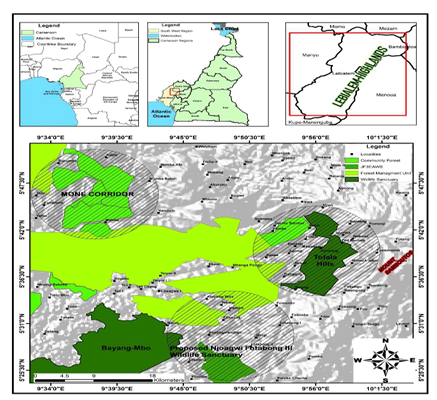
Study area and duration: Our study was conducted within the Lebialem Highlands, specifically encompassing the Tofala-Mone Corridor, Tofala Hill Wildlife Sanctuary, and Njaowi Fotabong III-Essoh Attah Wildlife Sanctuary. Located at 5°11'-5°45'N; 9°50'-10°00'E, on the Northeastern fringes of Cameroon’s Southwest Region, the Lebialem Highlands share boundaries with Momo Division to the North, the Banyang-Mbo Wildlife Sanctuary to the Southwest and South, and the West Region to the East (Fig. 1). This region spans an estimated 617 km2, extending from the Western flanks of Mount Bamboutous to the Bamilike Plateau, with altitudes reaching approximately 2500 m32.
Based on long-term meteorological records, the area experiences two distinct seasons: A rainy season from mid-March to the end of October, and a dry season from early November to mid-March. Annual rainfall averages 4526 mm, ranging from 3438 to 5429 mm (multi-year average)33. Climatic conditions vary with altitude: Higher elevations are characterized by cooler temperatures, lower rainfall, and higher humidity, often shrouded in cloud, while lower altitudes feature moderate temperatures and are generally clear. Daily temperatures typically range from 20°C to 35°C, with annual temperatures falling between 21°C and 26°C.
The landscape is undulating, with elevations generally ranging from 72 m (Besali) to approximately 2500 m (Fossimondi), including specific points like 570 m (Bechati) and 1470 m (Alongkong). This region functions as a vital watershed, feeding the Manyu River and supplying water to numerous areas including Mezam, Mifi, Mbamedjin Dam, Mbouda, Fontem, Tinto, and Mamfe18. Soil types vary with altitude: higher elevations feature humid volcanic soils of average fertility, while lower altitudes have sandy-loam to reddish alluvial soils of low fertility. The area supports both lowland and sub-montane forest vegetation32 and is recognized as a significant biodiversity hotspot. It hosts over 400 plant species (42 of which are threatened), two critically endangered great ape species-the Cross River gorilla (Gorilla gorilla diehli) and the Nigeria-Cameroon chimpanzee (Pan troglodytes ellioti)-along with several monkey species, eight globally threatened bird species, and three endemic amphibian species.
The Lebialem Highlands are home to approximately 133,000 people, distributed across 32 villages of varying sizes, with major clusters located around Fontem, Fossimondi, and Bechati34. The predominant ethnic groups-the Mundani, Nweh, and Bangwa peoples-each maintain distinct cultural relationships with forest resources and wildlife. Agriculture forms the primary livelihood, comprising subsistence farming of maize, cocoyam, and plantain, supplemented by cocoa as a cash crop. Other livelihood activities include hunting, fishing, artisanal logging, and crafts. Poverty is widespread, with most households living below or near the World Bank poverty line of USD 3 per day35, and access to formal employment and social services remains limited. These socioeconomic conditions exert significant pressure on forest resources, defining the primary human-use context for great ape conservation in the Lebialem Highlands.
Data collection: Data collection employed both household surveys and structured Focus Group Discussions (FGDs). In villages with fewer than 25 households, door-to-door surveys targeted at least 70% of all households. In larger villages, households were grouped for structured FGDs, with a maximum of 10 participants per group. Participants for both methods were randomly selected volunteers, aged at least 18 years (the minimum legal age for surveys under Cameroon Law). Participant identity was verified using National Identity Cards or through the local village chief. To accommodate language barriers, interviews were conducted in Pidgin English or translated into local dialects by a local field assistant. Overall, 378 household interviews and over 50 FGDs were completed across all 32 villages.
Trained field enumerators with prior experience in socio-ecological surveys administered the questionnaires. A three-person research team from ERUDeF supervised the enumerators to ensure consistency and data quality. The survey took place between October 2025 and January 2026. For sampling, household lists were obtained from local administrative records where available. In the absence of such lists, and given the unavailability of official government demographic data, household numbers were provided by village heads, and systematic sampling was applied by selecting every household along predefined transects or village paths. To avoid duplication, only one respondent per household (typically the household head or an adult representative) was interviewed.
The survey began with demographic questions (sex, age, income level, education, occupation, marital status, household size, and years of residence). Respondents were then asked about their knowledge of great apes, experiences with them, and their conservation views. To assess species recognition and ensure respondents could distinguish great apes from other primates, they were shown laminated photographs of Cross River gorillas, Nigeria-Cameroon chimpanzees, and local monkey species. The subsequent questions were designed to evaluate: Species recognition; knowledge of threats; behaviours during encounters with great apes, including experience of crop conflicts; attitudes towards hunting and protection; and perceptions of changes in hunting pressure and habitat over time.
Data analysis: Household survey responses to knowledge and attitude questions utilized categorical formats. For species recognition, respondents identified gorillas and chimpanzees from laminated photographs (yes/no). Perceived threats were captured via a multiple-choice selection from a pre-defined list (deforestation, hunting, climate change, disease, mining, and other). Attitudes towards protection were measured on a five-point Likert-type scale (strongly agree to strongly disagree), while conflict experience and behaviours during encounters were recorded as categorical items.
A FGD discussions were guided by a semi-structured topic guide covering the following themes: Historical changes in great ape populations; human-ape conflict experiences and community responses; cultural and spiritual significance of great apes; perceived effectiveness of existing conservation measures; and community suggestions for improved conservation strategies. A FGD responses were recorded, transcribed, and analyzed thematically to complement and contextualize survey findings.
Socioeconomic data were analyzed using SPSS Statistics software. Pearson Chi-square (χ2) tests determined the statistical significance of relationships between socio-demographic variables (age, education level, annual income) and conservation-related outcomes across all villages (p≤0.05; 95% confidence interval). To measure the strength of significant associations, Cramér’s V (for tables larger than 2×2) and phi (for 2×2 tables) were calculated alongside each chi-square result, where values of 0.10 indicated a weak association, 0.30 a moderate association, and 0.50 or above a strong association36. Other independent variables, such as village proximity to great ape habitat and tourism-related income, were not systematically available in administrative records and could not be consistently collected across all 32 villages. These have therefore been identified as priorities for future research. Each Chi-square test corresponds to one of the study’s four hypotheses (see Introduction): Tests of age, education, and income against knowledge and attitude outcomes address H1; tests of age against knowledge of threats address H2; tests of income against great ape meat consumption address H3; and tests of education against perceived ecological importance address H4.
RESULTS AND DISCUSSION
Demographic and Socioeconomic profile of respondents: Among the 378 respondents (Table 1-5), 70.11% were male and 29.89% female. The largest age group comprised those aged 35-40 years (30.2%). A significant proportion of the population were long-term residents, with 50.53% having lived in the area for over 20 years and 24.87% for exactly 20 years. Marital status showed a majority were married (69.05%), followed by single (15.08%), widowed (8.99%), and divorced (6.88%). Educational attainment was generally low: only 1.59% held a university degree, while 53.71% had only primary education, and 18.78% reported no formal education. Household size varied, with 19.0% having 5 members and 15.1% having 4 members. The predominant religion was Christianity (89.95%). In terms of annual income (measured in FCFA; 1 USD ≈ 563 FCFA as of January 2026), 27.5% of households earned 0-100,000 FCFA, and approximately 13.0% fell below the World Bank poverty line of USD 3 per day35. The most common economic activity was agriculture (42.3%), followed by small businesses/commerce (33.6%), hunting (7.4%), crafts (6.7%), and forestry (6.6%).
Pearson Chi-square analysis revealed several significant associations between socio-demographic characteristics and conservation perceptions (Table 6-8).
Local knowledge on the existence of great apes: A significant finding was that 86.2% of respondents accurately identified the presence of both gorilla and chimpanzee species in the Lebialem Highlands, distinguishing them from other primates like monkeys. They also correctly identified deforestation, poaching, and climate change as the primary threats to great apes.
| Table 1: | Gender and age distribution of respondents (n = 378) | |||
| Characteristics | Category | Number | Percent (%) |
| Gender | Male | 265 | 70.11 |
| Female | 113 | 29.89 | |
| Age group (years) | 20-24 | 16 | 4.2 |
| 25-29 | 29 | 7.7 | |
| 30-34 | 50 | 13.2 | |
| 35-40 | 114 | 30.2 | |
| 41-45 | 79 | 20.9 | |
| 46 and above | 90 | 23.8 |
| Table 2: | Marital status and educational characteristics of respondents | |||
| Characteristics | Category | Number | Percent (%) |
| Marital status | Single | 57 | 15.08 |
| Married | 261 | 69.05 | |
| Divorced | 26 | 6.88 | |
| Widowed | 34 | 8.99 | |
| Education level | No education | 71 | 18.78 |
| Primary | 203 | 53.71 | |
| Secondary | 98 | 25.92 | |
| University | 6 | 1.59 |
| Table 3: | Residence duration and household size of respondents | |||
| Characteristics | Category | Number | Percent (%) |
| Years of residence | Less than 1 year | 12 | 3.17 |
| 5 years | 37 | 9.79 | |
| 10 years | 19 | 5.03 | |
| 15 years | 25 | 6.61 | |
| 20 years | 94 | 24.87 | |
| Above 20 years | 191 | 50.53 | |
| Household size | 1 | 39 | 10.3 |
| 2 | 51 | 13.5 | |
| 3 | 22 | 5.8 | |
| 4 | 57 | 15.1 | |
| 5 | 72 | 19 | |
| 6 | 8 | 2.1 | |
| 7 | 51 | 13.5 | |
| 8 | 45 | 11.9 | |
| 9 | 33 | 8.7 |
| Table 4: | Religious affiliation and economic activities of respondents | |||
| Characteristics | Category | Number | Percent (%) |
| Religion | Christian | 340 | 89.95 |
| Muslim | 4 | 1.06 | |
| Animist | 11 | 2.91 | |
| Others | 23 | 6.08 | |
| Economic activity | Agriculture | 160 | 42.3 |
| Commerce | 127 | 33.6 | |
| Crafts | 25 | 6.7 | |
| Forestry | 25 | 6.6 | |
| Hunting | 28 | 7.4 | |
| Other | 13 | 3.4 |
| Table 5: | Annual income distribution of respondents (FCFA) | |||
| Characteristics | Category | Number | Percent (%) |
| Annual income (FCFA) | 0-100,000 | 104 | 27.5 |
| 101,000-200,000 | 88 | 23.3 | |
| 201,000-300,000 | 76 | 20.1 | |
| 301,000-400,000 | 49 | 13 | |
| Above 401,000 | 61 | 16.1 |
| Table 6: | Chi-square associations between age and conservation-related perceptions | |||
| Variable examined | Socio-demographic | χ2 | df | p-value | Significance | Cramér’s V/Phi |
| Recognition of great apes | Age | 66.077 | 66 | 0.474 | Not significant | 0.187 |
| Knowledge of threats to great apes | Age | 277.718 | 174 | <0.001 | Significant | 0.383 |
| Knowledge of protection status | Age | 25.826 | 24 | 0.362 | Not significant | - |
| Cultural/spiritual value perception | Age | 50.735 | 24 | 0.001 | Significant | 0.164 |
| Ecological importance of great apes and forests | Age | 110.311 | 42 | <0.001 | Significant | 0.242 |
| Discuss conservation with children | Age | 81.482 | 42 | <0.001 | Significant | 0.208 |
| Assess main threats to great apes | Age | 277.718 | 174 | <0.001 | Significant | - |
| Consumption of great ape meat | Age | 35.382 | 24 | 0.063 | Not significant | - |
| Practice farming | Age | 38.332 | 30 | 0.141 | Not significant | - |
| Perception of logging frequency | Age | 69.15 | 36 | 0.001 | Significant | 0.19 |
| Perception of agricultural expansion | Age | 68.568 | 42 | 0.006 | Significant | - |
| χ2: Pearson’s chi-square test, df: Degrees of freedom, p<0.05 was considered statistically significant | ||||||
| Table 7: | Chi-square associations between educational level and conservation-related perceptions | |||
| Variable examined | Socio-demographic | χ2 | df | p-value | Significance | Cramér’s V/Phi |
| Reaction to ape presence | Education level | 35.599 | 15 | 0.002 | Significant | 0.177 |
| Importance of great apes | Education level | 156.466 | 90 | <0.001 | Significant | 0.37 |
| Table 8: | Chi-square associations between annual income and conservation-related perceptions | |||
| Variable examined | Socio-demographic | χ2 | df | p-value | Significance | Cramér’s V/Phi |
| Reaction to ape presence | Annual income | 72.496 | 20 | <0.001 | Significant | 0.219 |
| Discuss conservation with children | Annual income | 82.92 | 28 | <0.001 | Significant | 0.175 |
| Consumption of great ape meat | Annual income | 46.286 | 16 | <0.001 | Significant | 0.191 |
| Practice farming | Annual income | 38.7 | 20 | 0.007 | Significant | - |
To assess human-ape coexistence, respondents described their behavior during encounters with great apes and reported any conflicts. Behaviors varied considerably: 35.7% stated they would simply observe the apes. However, a majority (52.9%) reported experiencing conflicts with great apes, primarily on their farms (37.0%) due to crop destruction (41.5%). This aligns with the known behavior of great apes, particularly chimpanzees, raiding agricultural fields, which can escalate to direct confrontations. Furthermore, 41.0% of respondents believed that attacks on people, including farmers and hunters, had significantly increased over the past 20 years.
While age had no significant impact on identifying or acknowledging the presence of great apes (χ2 = 66.077, P = 0.474), older respondents showed significantly greater knowledge of primary threats like deforestation and hunting compared to younger respondents (χ2 = 277.718, p<0.001). Additionally, reactions to ape presence were significantly associated with both education level (χ2 = 35.599, P = 0.002) and annual income (χ2 = 72.496, p<0.001).
Local perception and attitude towards great apes: Regarding the hunting or killing of great apes, 23.3% of respondents strongly disagreed with the statement that great apes should not be hunted or killed. Despite this, a notable 86.2% were aware that great apes are legally protected species, and 46.8% agreed that wildlife, especially great apes, should be protected. Furthermore, 19.6% regularly discussed the benefits of forest and wildlife conservation with their children.
Age had no significant influence on knowledge of the protection status of great apes (χ2 = 25.826, P = 0.362). However, older respondents demonstrated a significantly greater appreciation for the cultural and spiritual values of great apes (χ2 = 50.735, P = 0.001), as well as their ecological importance and that of forests (χ2 = 110.311, p<0.001), and were significantly more likely to discuss conservation with their children (χ2 = 81.482, p<0.001). This discussion of conservation with children was also positively associated with higher annual income (χ2 = 82.920, P<0.001). Moreover, age significantly influenced respondents’ ability to assess the main threats to great apes (χ2 = 277.718, p<0.001), and educational level positively influenced the perceived importance of great apes (χ2 = 156.466, p<0.001).
Pressure on great apes and their habitats: Compared to the past five years, 45.8% of respondents reported a significant decrease in the availability of gorilla or chimpanzee meat in local markets. Concurrently, 39.9% noted a substantial reduction in the number of vendors selling great ape bushmeat. These trends reduced availability and fewer sellers could indicate either decreased hunting pressure, declining great ape populations, or a combination of both; however, perception data alone cannot differentiate between these possibilities. Furthermore, 42% of respondents identified providing alternative livelihoods as the most effective strategy for reducing pressure on great apes and their habitats.
To understand indirect habitat pressures, respondents characterized changes in logging frequency and agricultural expansion over the past five years, as these are primary drivers of great ape habitat loss in the area. Chi-square analysis revealed that while age had no significant influence on great ape meat consumption (χ2 = 35.382, P = 0.063) or the ability to practice farming (χ2 = 38.332, P = 0.141), it significantly influenced the ability to characterize logging frequency (χ2 = 69.150, P = 0.001) and agricultural expansion (χ2 = 68.568, P = 0.006), with older respondents demonstrating greater awareness of these changes. Annual income, in turn, significantly influenced both great ape meat consumption (χ2 = 46.286, p<0.001) and farming activity (χ2 = 38.700, P = 0.007).
A significant demographic limitation of our sample was that 70.11% of respondents were male. This reflects the cultural norm in the Lebialem Highlands, where male household heads are the primary point of contact for outside researchers, and introduces a sampling bias that warrants consideration when interpreting gender-differentiated findings. Despite this caveat, the socioeconomic profile of respondents reveals several trends directly relevant to great ape conservation management.
The majority of respondents were married (69.05%) and within the economically active age range (35-45 years), with 50.53% having resided in the area for more than 20 years. Long-term residency often intensifies reliance on natural resources, particularly because deeply rooted land-use traditions are challenging to alter without viable economic alternatives. Furthermore, older community members have accumulated substantial local ecological knowledge that conservation programs can actively leverage.
Low educational attainment, with 53.71% of respondents having only primary education and 18.78% no education, poses a significant conservation challenge. Our results demonstrate that educational level significantly predicts appreciation of the ecological importance of great apes (χ2 = 156.466, p<0.001). Limited education reduces access to formal employment, keeps households dependent on forest resources, and limits awareness of conservation regulations and sustainable land-use alternatives36,37.
Furthermore, widespread poverty, evidenced by 27.5% of households earning below 100,000 FCFA annually and many falling below the World Bank poverty line35, is a major driver of natural resource exploitation, including deforestation, hunting, and Non-Timber Forest Product (NTFP) collection38. Additionally, differences in income across villages suggest uneven access to markets and infrastructure, which can produce spatially heterogeneous conservation pressures.
As the analysis relies entirely on bivariate Pearson Chi-square tests, it is not possible to determine which socio-demographic variables independently explain conservation attitudes when controlling for others. For example, variables such as age, education, income, and years of residence are likely to be interrelated. Therefore, older respondents, for instance, may also have lower formal education and lower income, implying that the apparent effects of each variable may partly reflect the influence of the others. Consequently, comparisons of the relative explanatory power of age, education, and income are interpreted cautiously. This limitation highlights an avenue for future research that could employ multivariate approaches to rigorously disentangle independent effects.
An important observation was that 86.2% of respondents correctly identified both gorilla and chimpanzee species in the area and could distinguish them from monkeys, as confirmed through photo-identification during interviews. This high recognition rate reflects generations of direct coexistence between these communities and great apes, and highlights the value of integrating local ecological knowledge into conservation planning18,39.
Importantly, while age did not affect the basic ability to recognize great ape species (χ2 = 66.077, P = 0.474), older respondents demonstrated significantly greater knowledge of the threats facing great apes (χ2 = 277.718, p<0.001). Therefore, accumulated life experience appears to build a deeper understanding of ecosystem dynamics and conservation challenges that younger community members lack.
Respondents identified deforestation, hunting, and climate change as the main threats to great apes, showing awareness of both direct and indirect drivers of decline. Over half of respondents reported conflicts with great apes, primarily through crop damage. Although our survey did not include a direct comparative ranking of crop raiders, respondents specifically attributed crop destruction to chimpanzees and gorillas. Responses during encounters ranged from passive observation (35.7%) to defensive actions, such as making noise, throwing objects, or chasing apes away from farms. These responses were significantly associated with education level (χ2 = 35.599, P = 0.002) and annual income (χ2 = 72.496, p<0.001). Specifically, higher-income and more-educated respondents tended to observe passively, whereas lower-income respondents, who depend directly on crops for food security, were more likely to take aggressive defensive action.
Perceptions of great ape attacks on people over the past 20 years were mixed, with 41.0% believing attacks had increased. Although most respondents denied directly hunting great apes, annual income was a significant predictor of great ape meat consumption (χ2 = 46.286, p<0.001). Lower-income households were significantly more likely to report consuming great ape bushmeat, suggesting it serves as an important protein source for economically marginalized families. Age was not a significant predictor (P = 0.063), indicating that consumption occurs across all age groups.
An additional avenue worth noting for future consideration is wildlife-based ecotourism. Evidence from Rwanda and Malawi suggests that revenue-sharing programmes linked to gorilla tourism can strengthen community support for conservation22,23. Although this study did not assess tourism feasibility or community willingness for tourism-based livelihoods, the finding that income level is a decisive predictor of conservation attitudes (χ2 = 46.286, p<0.001) implies that any mechanism generating sustainable income tied to great ape survival could reduce bushmeat consumption40,41. Therefore, the viability of community-based ecotourism in the Lebialem Highlands warrants dedicated future investigation.
CONCLUSION
This study presents the first socioeconomic assessment of community knowledge, perceptions, and attitudes concerning great ape conservation in Cameroon’s Lebialem Highlands. Our findings reveal that age, income, and educational attainment are significant predictors of conservation-relevant knowledge and attitudes, offering clear and actionable implications for conservation management.
Specifically, older community members exhibited significantly greater awareness of threats to great apes (χ2 = 277.718, p<0.001) and were more inclined to discuss conservation with their children (χ2 = 81.482, p<0.001), positioning them as valuable partners for intergenerational conservation education initiatives. Higher educational attainment correlated with a stronger appreciation for the ecological importance of great apes (χ2=156.466, p<0.001), highlighting formal education as a crucial conservation lever. Conversely, lower household income was the strongest predictor of great ape meat consumption (χ2=46.286, p<0.001), underscoring the necessity of integrating poverty reduction into conservation strategies, rather than treating it as a distinct development issue.
The broadly positive attitudes observed in this study, with 86.2% of respondents aware of the protected status of great apes and most expressing pride in coexisting with them, establish a strong social foundation for community-based conservation efforts.
Our findings offer actionable insights for great ape population management. Conservation education programs should engage older community members as ecological knowledge-holders, leveraging the natural intergenerational knowledge transmission within these communities. Furthermore, promoting alternative livelihood programs such as sustainable agroforestry, value chain development, and microenterprise support specifically targeted at lower-income households will help reduce dependence on great ape bushmeat. Similarly, developing participatory crop-protection schemes can mitigate human-ape conflict and associated retaliatory behaviors towards great apes. Additionally, systematic great ape population monitoring across the Lebialem landscape is crucial to distinguish genuine declines in hunting pressure from potential population collapse. Therefore, when implemented in tandem, these integrated measures can foster the long-term coexistence of Lebialem communities and great apes, safeguarding both their populations and habitats.
SIGNIFICANCE STATEMENT
This study provides the first theory-driven, integrated socioeconomic analysis of local knowledge, perceptions, and attitudes toward great ape conservation in Cameroon’s Lebialem Highlands. The research demonstrates that household socio-demographic factors specifically age, income, and education, are primary predictors of conservation-relevant attitudes and practices.
INSTITUTIONAL REVIEW BOARD STATEMENT
Data collection was carried out in collaboration with the Environment and Rural Development Foundation (ERUDeF).
DATA AVAILABILITY STATEMENT
The datasets generated in this study are not publicly accessible as they contain information obtained from human participants, requiring confidentiality. Anonymous data supporting the findings can be obtained upon reasonable request from the corresponding author.
ETHICAL STATEMENT
This study, which involved human participants through household surveys and focus group discussions, was conducted in accordance with recognised ethical principles for research involving human subjects. Prior to data collection, the research protocol was reviewed internally by the Environment and Rural Development Foundation (ERUDeF) research team to confirm compliance with standard ethical guidelines for social science and conservation research; as the study posed minimal risk, did not involve vulnerable populations, and did not collect medical or other sensitive personal data, it did not require review by a formal institutional ethics committee and no formal approval or reference number was issued. Before each interview or focus group discussion, participants were informed of the study’s purpose, the voluntary nature of their involvement, and their right to withdraw at any time without consequence, and verbal informed consent was obtained from all participants prior to data collection, consistent with local literacy levels and accepted practice in the study area. Participant confidentiality and anonymity were maintained throughout the study: No personally identifying information was recorded on questionnaires or focus group transcripts, unique identifier codes were used in place of participant names during data entry and analysis, and all data were stored securely and accessible only to the research team.
REFERENCES
- Junker, J., S. Blake, C. Boesch, G. Campbell and L. du Toit et al., 2012. Recent decline in suitable environmental conditions for African great apes. Divers. Distrib., 18: 1077-1091.
- Roopsind, A., B. Sohngen and J. Brandt, 2019. Evidence that a national REDD+ program reduces tree cover loss and carbon emissions in a high forest cover, low deforestation country. Proc. Natl. Acad. Sci. U.S.A., 116: 24492-24499.
- Osuri, A.M., U. Mendiratta, R. Naniwadekar, V. Varma and S. Naeem, 2019. Hunting and forest modification have distinct defaunation impacts on tropical mammals and birds. Front. For. Global Change, 2.
- Beckline, M. and V. Ntoko, 2022. Impact of micro-climate change on the forest vegetation resources of the Mount Cameroon Region. Am. J. Environ. Prot., 10: 57-66.
- Velastegui-Montoya, A., N. Montalván-Burbano, G. Peña-Villacreses, A. de Lima and G. Herrera-Franco, 2022. Land use and land cover in tropical forest: Global research. Forests, 13.
- Ekoungoulou, R., J.L.O. Ayessa, B. Mukete, M.C. Mouaya, F.D. Dibala, F. Mankessi and F. Koubouana, 2025. Application of allometric models in estimating above- and below-ground biomass carbon stock in planted forests of Congo. Open J. For., 15: 199-209.
- Mbile, P., B. Mukete, H. Ettagbor, M. Vabi and L. Besinga et al., 2025. A case for community-led biodiversity conservation in Africa’s lower Guinea Forest Ecosystem. Acad. Environ. Sci. Sustainability, 2.
- Wright, J.H. and N.E.C. Priston, 2010. Hunting and trapping in Lebialem Division, Cameroon: Bushmeat harvesting practices and human reliance. Endanger. Species Res., 11: 1-12.
- Hicks, T.C., L. Darby, J. Hart, J. Swinkels, N. January and S. Menken, 2010. Trade in orphans and bushmeat threatens one of the Democratic Republic of the Congo’s most important populations of Eastern chimpanzees (Pan troglodytes schweinfurthii). Afr. Primates, 7: 1-18.
- Moore, D.L. and L. Vigilant, 2014. A population estimate of chimpanzees (Pan troglodytes schweinfurthii) in the Ugalla region using standard and spatially explicit genetic capture–recapture methods. Am. J. Primatol., 76: 335-346.
- Carvalho, J.S., B. Graham, G. Bocksberger, F. Maisels and E.A. Williamson et al., 2021. Predicting range shifts of African apes under global change scenarios. Divers. Distrib., 27: 1663-1679.
- Strindberg, S., F. Maisels, E.A. Williamson, S. Blake and E.J. Stokes et al., 2018. Guns, germs, and trees determine density and distribution of gorillas and chimpanzees in Western Equatorial Africa. Sci. Adv., 4.
- Heinicke, S., R. Mundry, C. Boesch, B. Amarasekaran and A. Barrie et al., 2019. Advancing conservation planning for western chimpanzees using IUCN SSC A.P.E.S.-the case of a taxon-specific database. Environ. Res. Lett., 14.
- Jones, K.R., O. Venter, R.A. Fuller, J.R. Allan, S.L. Maxwell, P.J. Negret and J.E.M. Watson, 2018. One-third of global protected land is under intense human pressure. Science, 360: 788-791.
- Junker, J., L. Quoss, J. Valdez, M. Arandjelovic and A. Barrie et al., 2024. Threat of mining to African great apes. Sci. Adv., 10.
- Wade, A.H. and N. Malone, 2021. Ecological, historical, economic, and political factors shaping the human-gorilla interface in the Mone-Oku Forest, Cameroon. Diversity, 13.
- Chuo, M.D. and T.E. Angwafo, 2017. Chimpanzee in ethno-primatological practices and it implications for biodiversity conservation: Kimbi-Fungom National Park and Kom-Wum Forest Reserve, Cameroon. Am. J. Agric. For., 5: 157-172.
- Njukang, A.P., S.R. Akwanjoh, T.E. Angwafor, M.D. Chuo and N.T. Amin, 2019. Knowledge, attitudes and perceptions of the local people towards the conservation of the Nigeria-Cameroon chimpanzee (Pan troglodytes ellioti) in the Tofala Hill Wildlife Sanctuary (THWS), South West Region, Cameroon. Int. J. Rural Dev. Environ. Health Res., 3: 53-61.
- Hofner, A.N., C.A.J. Robinson and K.A.I. Nekaris, 2018. Preserving Preuss’s red colobus (Piliocolobus preussi): An ethnographic analysis of hunting, conservation, and changing perceptions of primates in Ikenge-Bakoko, Cameroon. Int. J. Primatol., 39: 895-917.
- Fotang, C., U. Bröring, C. Roos, P. Dutton and L.R.D. Tédonzong et al., 2023. Mapping suitable habitat for Nigeria-Cameroon chimpanzees in Kom-Wum forest reserve, North-Western Cameroon. Primates, 64: 339-350.
- Kormos, R., C.F. Kormos, T. Humle, A. Lanjouw and H. Rainer et al., 2014. Great apes and biodiversity offset projects in Africa: The case for national offset strategies. PLoS ONE, 9.
- Tuyisingize, D., B.A. Kaplin, W. Eckardt, A. Musana and D. Caillaud, 2023. Distribution and conservation status of the golden monkey Cercopithecus mitis kandti in Rwanda. Oryx, 57: 98-106.
- Mandoloma, L., H. Travers, M. Clark, L. Coad, K. Hughes and E.J. Milner-Gulland, 2026. Predicting people's priorities for reconciling food security and biodiversity conservation in Kasungu, Malawi. Conserv. Sci. Pract., 8.
- Gross, E.M., J.G. Pereira, T. Shaba, S. Bilério, B. Kumchedwa and S. Lienenlüke, 2022. Exploring routes to coexistence: Developing and testing a human-elephant conflict-management framework for African elephant-range countries. Diversity, 14.
- Mfossa, D.M., E. Gazagne, R.J. Gray, M.E. Ketchen and E.A. Abwe et al., 2023. Montane grassland resources drive gorilla (Gorilla gorilla) nesting behaviors in the Ebo forest, Littoral Region, Cameroon. Eur. J. Wildl. Res., 69.
- Nkemnyi, M.F., A. de Haas, N.D. Etiendem and F. Ndobegang, 2013. Making hard choices: Balancing indigenous communities livelihood and Cross River gorilla conservation in the Lebialem-Mone Fforest landscape, Cameroon. Environ. Dev. Sustainability, 15: 841-857.
- Bobo, K.S. and R.B. Weladji, 2011. Wildlife and land use conflicts in the Mbam and Djerem conservation Region, Cameroon: Status and mitigation measures. Hum. Dimens. Wildl., 16: 445-457.
- van Leeuwen, K.L., R.A. Hill and A.H. Korstjens, 2020. Classifying chimpanzee (Pan troglodytes) landscapes across large-scale environmental gradients in Africa. Int. J. Primatol., 41: 800-821.
- Meyer, M. and J. Börner, 2022. Rural livelihoods, community-based conservation, and human-wildlife conflict: Scope for synergies? Biol. Conserv., 272.
- Pooley, S., S. Bhatia and A. Vasava, 2021. Rethinking the study of human-wildlife coexistence. Conserv. Biol., 35: 784-793.
- Sabuhoro, E., B. Wright, I.E. Munanura, I.N. Nyakabwa and C. Nibigira, 2021. The potential of ecotourism opportunities to generate support for mountain gorilla conservation among local communities neighboring Volcanoes National Park in Rwanda. J. Ecotourism, 20: 1-17.
- Mfossa, D.M., E.E. Abwe, R.C. Whytock, B.J. Morgan and M.C. Huynen et al., 2022. Distribution, habitat use and human disturbance of gorillas (Gorilla gorilla) in the Ebo forest, Littoral Region, Cameroon. Afr. J. Ecol., 60: 895-907.
- Nchanji, A., 2005. Elephant-poaching weapons and new experiences from the Banyang-Mbo Wildlife Sanctuary, Cameroon. Pachyderm, 39: 33-42.
- Nkemnyi, M.F., T. de Herdt, G.B. Chuyong and T. Vanwing, 2016. The influence of institutions on access to forest resources in Cameroon: The case of Tofala Hill Wildlife Sanctuary. J. Nat. Conserv., 34: 42-50.
- Jolliffe, D., D.G. Mahler, C. Lakner, A. Atamanov and S.K. Tetteh-Baah, 2025. Poverty and prices: Assessing the impact of the 2017 PPPs on the international poverty line and global poverty. World Bank Econ. Rev., 39: 497-521.
- Vaske, J.J., 2008. Survey Research and Analysis: Applications in Parks, Recreation and Human Dimensions. Venture Publishing, Pennsylvania, United States, ISBN: 9781892132796, Pages: 635.
- Mukete, B., Y. Sun, D. Etongo, R. Ekoungoulou, F. Folega, S. Sajjad, M. Ngoe and G. Ndiaye, 2018. Household characteristics and forest resources dependence in the Rumpi Hills of Cameroon. Appl. Ecol. Environ. Res., 16: 2755-2779.
- Beckline, M., S. Yujun, D. Etongo, S. Saeed and Abdul Mannan, 2018. Assessing the drivers of land use change in the Rumpi hills forest protected area, Cameroon. J. Sustainable For., 37: 592-618.
- Fedele, G., C.I. Donatti, I. Bornacelly and D.G. Hole, 2021. Nature-dependent people: Mapping human direct use of nature for basic needs across the tropics. Global Environ. Change, 71.
- Ingram, D.J., G.Z.L. Froese, D. Carroll, P.C. Bürkner and F. Maisels et al., 2025. Regional patterns of wild animal hunting in African tropical forests. Nat. Sustainability, 8: 202-214.
- van der Hoek, Y., F. van de Perre, C. Fastré, L. Kirkpatrick and U. Ngobobo et al., 2024. Short-term trends in great ape density in a community-based conservation area in the Eastern Democratic Republic of the Congo. Ecol. Solutions Evidence, 5.
How to Cite this paper?
APA-7 Style
Nkembi, L., Mukete, B., Nkemndem, A., Vivian, A., Ngoe, M., Yang, W., Sylvie, F., & Nkengafac, N. (2026). Socioeconomic influences on great ape conservation in the lebialem highlands, cameroon. Science International, 14(1), 100–113. https://doi.org/10.17311/sciintl.2026.100.113
ACS Style
Nkembi, L.; Mukete, B.; Nkemndem, A.; Vivian, A.; Ngoe, M.; Yang, W.; Sylvie, F.; Nkengafac, N. Socioeconomic Influences on Great Ape Conservation in the Lebialem Highlands, Cameroon. Sci. Int 2026, 14 (1), 100–113. https://doi.org/10.17311/sciintl.2026.100.113
AMA Style
Nkembi L, Mukete B, Nkemndem A, et al. Socioeconomic influences on great ape conservation in the lebialem highlands, cameroon. Science International. 2026;14(1):100–113. doi:10.17311/sciintl.2026.100.113
Chicago/Turabian Style
Nkembi, Louis, Beckline Mukete, Agendia Nkemndem, et al. 2026. “Socioeconomic Influences on Great Ape Conservation in the Lebialem Highlands, Cameroon.” Science International 14 (1): 100–113. https://doi.org/10.17311/sciintl.2026.100.113

This work is licensed under a Creative Commons Attribution 4.0 International License.

