
Advancing Circular Economy in Chemical Engineering: Strategies for Waste Reduction and Resource Recovery
-
Brighotaye Cheery Vaekosen
Department of Chemical Engineering, Faculty of Engineering, Federal University of Technology Minna, Minna, Niger State, Nigeria
Kenechukwu Fortunate ChukwurahUniversity of Hull, United Kingdom
Ibrahim IbrahimDepartment of Chemical engineering, Faculty of Engineering, Ahmadu Bello University, Zaria, Kaduna State, Nigeria
Moses Abah Adondua

ResearchHub Nexus Institute, Nigeria
Micheal Oladosu AbimbolaResearchHub Nexus Institute, Nigeria
| Received 30 Jun, 2026 |
Accepted 07 Sep, 2026 |
Published 20 Sep, 2026 |
The circular economy (CE) paradigm offers a transformative pathway for chemical engineering by shifting industrial systems from the conventional linear “take-make-dispose” model toward regenerative, resource-efficient processes. This review critically examines strategies for waste reduction and resource recovery within chemical process industries, highlighting the integral role of chemical engineers in enabling circular systems. We explore the principles of circular process and product design, emphasizing green chemistry, atom economy, and design-for-reuse and recyclability strategies. Process intensification, modular manufacturing, and early integration of life cycle thinking are discussed as key enablers for minimizing waste at the source. The review further evaluates advanced resource recovery and valorization technologies, including mechanical and chemical recycling, thermochemical and biological conversion pathways, and the recovery of critical materials such as metals, nutrients, and CO2. Systems-level circular engineering approaches, encompassing closed-loop process integration, carbon capture and utilization, digitalization, and incorporation of renewable feedstocks, are analyzed to illustrate pathways toward industrial-scale circularity. Sustainability assessment frameworks, including life cycle assessment (LCA), techno-economic analysis (TEA), and circularity performance metrics, are highlighted to quantify environmental, economic, and operational trade-offs. Finally, the review identifies key technical, economic, and regulatory challenges, and outlines emerging research frontiers such as hybrid thermochemical-biological systems, advanced catalysis, and smart manufacturing for circular process industries. This synthesis provides a comprehensive, high-level resource for researchers, engineers, and policymakers, aiming to guide the transition toward more sustainable, resilient, and economically viable chemical process systems aligned with circular economy principles.
| Copyright © 2026 Vaekosen et al. This is an open-access article distributed under the Creative Commons Attribution License, which permits unrestricted use, distribution, and reproduction in any medium, provided the original work is properly cited. |
INTRODUCTION
The accelerating depletion of natural resources and escalating waste generation have intensified the global transition from the linear “take-make-dispose” model toward a circular economy (CE). Unlike conventional production systems that externalize environmental costs, the CE framework seeks to design out waste, retain material value, and regenerate resources through closed-loop industrial systems1,2. This paradigm shift is particularly significant for chemical engineering, a discipline that governs large-scale material transformation and resource utilization. Embedding circularity within chemical industries requires rethinking feedstock selection, reaction pathways, separation technologies, and product design to minimize losses at the molecular and process levels3,4. Furthermore, the convergence of CE principles with Industry 5.0 underscores the importance of digitalization, resilience, and sustainability in next-generation process systems2. As such, chemical engineering is increasingly recognized not only as a production-oriented field but also as a strategic enabler of systemic sustainability transformation.
Operationalizing circular economy principles demands coordinated technological and systemic innovation. Green chemistry provides foundational tools for source reduction through safer chemical design, improved atom economy, and reduced toxicity3. Process intensification advances these objectives by enhancing reaction efficiency, optimizing heat and mass transfer, and enabling compact, energy-efficient systems capable of recovering valuable intermediates from waste streams4. Integrating life-cycle assessment into early-stage process design ensures that intensified or alternative technologies deliver genuine environmental improvements rather than shifting impacts across supply chains4,5. Beyond individual processes, industrial ecology frameworks promote cascading material use and collaborative resource sharing across sectors to strengthen circular performance5,6. Collectively, these approaches reflect a shift from isolated efficiency improvements toward holistic material stewardship embedded within interconnected industrial ecosystems.
Technological advances in resource recovery and valorization further demonstrate the feasibility of circular chemical systems. In the plastics sector, catalytic depolymerization, solvent-based purification, and advanced chemical recycling technologies enable the conversion of post-consumer polymers into high-value monomers and fuels, addressing limitations of conventional mechanical recycling7,8. Integrated thermochemical and biochemical platforms extend circularity by co-processing biomass and plastic residues, thereby increasing feedstock flexibility and product diversity8. Industrial symbiosis initiatives complement these technological innovations by facilitating the exchange of energy, by-products, and materials among firms to reduce overall resource extraction and environmental burdens5,6. Such developments illustrate how chemical engineers can transform waste liabilities into economic assets through advanced catalysis, integrated process design, and cross-sector collaboration.
Nevertheless, achieving large-scale circular transition requires rigorous evaluation and supportive governance structures. Life-cycle assessment remains indispensable for quantifying environmental impacts across production, recovery, and reuse stages, preventing unintended burden shifting4. Techno-economic considerations determine whether circular technologies can compete with established linear processes under real market conditions1. The integration of digital monitoring and smart manufacturing systems, emphasized within Industry 5.0 discourse, further enhances traceability and resource efficiency across industrial networks2. In parallel, policy-supported industrial symbiosis frameworks demonstrate how coordinated institutional mechanisms can accelerate waste-to-resource innovation and improve system-wide sustainability outcomes6. These dimensions highlight that circular chemical engineering is both a technological challenge and a systemic transformation requiring alignment among innovation, evaluation, and governance.
This review provides a structured synthesis of circular economy implementation within chemical engineering, focusing specifically on waste reduction and resource recovery as central mechanisms for sustainable industrial transformation. It examines how molecular-level design strategies rooted in green chemistry can be integrated with process intensification techniques to minimize material losses at source. The review evaluates emerging valorization technologies, including catalytic recycling, thermochemical conversion, and integrated biomass-plastic processing systems, that convert diverse waste streams into valuable feedstocks. Systems-level approaches such as industrial symbiosis, closed-loop process integration, and digitally enabled manufacturing are analyzed to demonstrate how interconnected networks enhance efficiency and resilience. Sustainability assessment tools are discussed to clarify how environmental performance, economic feasibility, and scalability considerations shape implementation pathways. By linking conceptual foundations with applied technologies and systemic frameworks, this article aims to provide researchers, engineers, and policymakers with a coherent roadmap for embedding circular principles into chemical process industries and advancing resource-efficient, low-carbon, and economically viable production systems.
CIRCULAR PROCESS AND PRODUCT DESIGN
Circular design in chemical engineering integrates sustainability principles directly into molecular, process, and product frameworks to ensure that materials and systems are optimized for minimal waste and maximal reuse. At the core of this transformation is green chemistry, which prioritizes designing chemical products and processes that reduce or eliminate hazardous substances, minimize environmental impact, and enhance resource efficiency9. Green chemistry principles align with CE objectives because they encourage the selection of renewable feedstocks, safer reagents, and catalysts that increase atom economy while reducing by-product generation. These principles not only mitigate ecological harm but also provide a foundation for designing processes that are inherently recyclable and compatible with downstream recovery systems7,10. An essential component of circular process design is process intensification (PI), which aims to make chemical operations more efficient by combining multiple unit operations, enhancing mass and heat transfer, and reducing equipment footprints. Recent discourse emphasizes that PI technologies such as oscillatory flow reactors, membrane separations, and photochemical reactors can significantly reduce energy consumption and improve the recovery of valuable substances from complex feedstocks within a circular context10,11. PI also intersects with green chemistry by enabling continuous flow and multifunctional systems that limit waste and accelerate reaction kinetics, thereby supporting both environmental and economic sustainability objectives2,7.
Design for durability, reuse, and recyclability represents another critical facet of circular design, especially at the product level. Polymers and materials engineered for closed-loop recycling, where materials can be continually reprocessed without loss of function, are key examples of this philosophy. Recent reviews highlight the development of bio-based, closed-loop recyclable polymers that employ dynamic covalent bonds or reversible chemistries, which allow materials to be depolymerized and re-synthesized with minimal degradation in performance12. These material innovations illustrate how design strategies expand beyond process efficiency to encompass end-of-life considerations, ensuring that products are engineered from the start to be reintegrated into the production cycle rather than discarded. Another strategic dimension of circular design is the integration of life-cycle thinking into both process and product development. Life cycle assessment (LCA) and sustainability indicators are increasingly used to guide early design decisions, enabling engineers to identify environmental hotspots and optimize resource flows across the entire value chain2,10. This systems perspective shifts design paradigms from localized optimization focused solely on yield or cost to a holistic assessment of performance across material extraction, manufacturing, operation, and end-of-life stages. Embedding life-cycle thinking ensures that circular strategies do not inadvertently create burden shifts or trade-offs that undermine long-term sustainability gains.
Finally, circular process and product design increasingly incorporates digital tools and data-driven methods to accelerate innovation and decision-making. Advanced modelling, simulation, and optimization frameworks support the exploration of alternative process configurations, predict recyclability outcomes, and facilitate real-time monitoring of resource use efficiency2,10. These digital enablers enhance the ability of chemical engineers to design systems that are adaptive, flexible, and aligned with circular objectives.
|
Ultimately, circular design in chemical engineering is not a single methodology but a composite of green chemistry, process intensification, durable materials design, life-cycle integration, and digital innovation all working in concert to close material loops and redefine what constitutes sustainable process and product systems.
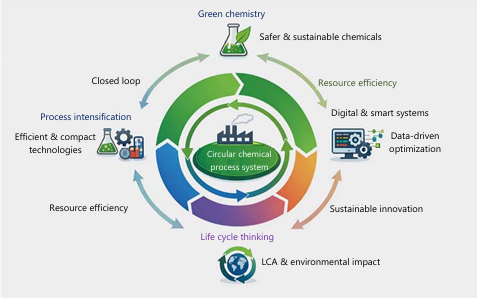
Figure 1 illustrates how circular economy principles are implemented across chemical engineering scales. The framework integrates molecular-level green chemistry, process intensification, system-level life-cycle thinking, and digital optimization to enable efficient material use, resource recovery, and closed-loop processes
Waste prevention and process optimization: Waste prevention and process optimization form the backbone of circular economy implementation in chemical engineering, aiming to minimize environmental impacts while enhancing resource efficiency. By addressing waste at its source and improving process efficiency, chemical industries can transform potential liabilities into valuable resources, thereby promoting sustainability across multiple scales of production1,4.
Cleaner production and source reduction: Cleaner production emphasizes inherent safety and waste prevention by designing processes that reduce hazardous materials, optimize raw material use, and avoid unnecessary waste generation1,13. Incorporating lean manufacturing principles such as value stream mapping, just-in-time production, and continuous improvement cycles further reduces material and energy waste, eliminates inefficiencies, and enhances operational sustainability1,14. These approaches not only minimize the environmental footprint but also provide economic benefits by lowering raw material and disposal costs.
Reaction and separation optimization: Optimizing reactions and separation processes is essential to maximize yield and minimize by-product formation. Techniques such as advanced catalysis, process intensification, and energy-efficient separations enable high conversion efficiencies while reducing waste streams and energy consumption4,8. For example, membrane separations, adsorption technologies, and integrated reaction-separation configurations allow selective recovery of products and solvents, thereby lowering operational energy use and emissions1,13. These methods align with circular principles by ensuring that fewer resources are lost and more materials remain in productive use.
|
Industrial symbiosis and by-product valorization: Industrial symbiosis involves exchanging by-products, energy, and residual streams between industrial processes to minimize waste and maximize resource efficiency. In circular industrial clusters, waste from one process becomes a feedstock for another, creating closed-loop material flows and reducing reliance on virgin resources6,15. Case studies in forest-based clusters and chemical parks illustrate how cross-sector collaborations can convert biomass residues and industrial waste into energy, chemicals, and other value-added products13,16. By-product valorization strategies not only reduce landfill disposal but also generate economic value, enhancing sustainability and competitiveness within industrial ecosystems8,17.
Integration of strategies for circularity: Combining cleaner production, optimized reaction and separation processes, and industrial symbiosis creates a holistic framework for waste minimization and resource recovery. Such integration facilitates circular bioeconomy pathways, enabling the conversion of solid and liquid waste into fuels, chemicals, or materials, while reducing environmental impact8,13. Recent advances in flexible large-scale co-production systems for instance, methanol and ammonia synthesis demonstrate how cross-industry collaboration and integrated process design can enhance both material efficiency and environmental sustainability16. Overall, these strategies illustrate the transformative potential of waste prevention and process optimization in advancing circular chemical manufacturing.
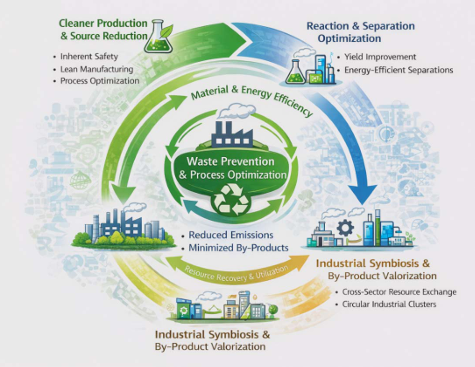
Figure 2 depicts the integration of key circular strategies: Cleaner Production and Source Reduction, Reaction and Separation Optimization, and Industrial Symbiosis and By-Product Valorization. Arrows show flows and feedback loops, highlighting circularity, material efficiency, and resource recovery.
Resource recovery and valorization technologies: Resource recovery and valorization technologies are critical enablers of circular chemical engineering, transforming waste streams into valuable products, energy, and raw materials. By recovering resources from industrial, municipal, and agricultural wastes, these technologies reduce environmental burdens, conserve natural resources, and enhance the sustainability of chemical processes1,8. This section reviews recent advances in mechanical and chemical recycling, thermochemical conversion, biological systems, and recovery of strategic resources, highlighting technologies that promote circularity in modern chemical engineering.
|
Mechanical and chemical recycling: Mechanical and chemical recycling form the foundation of material recovery. Mechanical recycling involves sorting, shredding, and reprocessing polymers to produce secondary feedstocks suitable for industrial use. While effective for single-polymer waste streams, it is limited by contamination and material degradation over multiple cycles17,18. Chemical recycling, including depolymerization and solvent-based processes, overcomes these limitations by breaking polymers into monomers or high-value chemical intermediates, enabling recycling of complex or multilayer plastics. Advanced recycling methods increase the range of treatable materials and enhance product quality, supporting closed-loop plastic management8,18.
Thermochemical conversion pathways: Thermochemical technologies such as pyrolysis, gasification, and hydrothermal processing convert organic and polymeric wastes into energy and chemical feedstocks. Pyrolysis decomposes waste in the absence of oxygen to produce bio-oil, syngas, and char, which can be further refined into fuels or chemical intermediates1. Gasification generates syngas suitable for electricity, heat, or chemical synthesis, while hydrothermal processing converts wet biomass into biocrude efficiently. Integration with waste-to-energy systems allows recovered energy to offset industrial demands, improving both environmental and economic performance8.
Biological and bio-integrated systems: Biological systems enable the recovery of organic waste through processes such as anaerobic digestion (AD), which produces biogas while stabilizing residual biomass for reuse. Biorefineries further integrate multiple biochemical pathways to convert biomass into fuels, chemicals, and materials, enhancing resource efficiency and circularity1,19. Hybrid systems combining thermal and biological processes, such as pre-treatment of biomass via hydrothermal liquefaction followed by AD, optimize energy and material recovery while minimizing environmental impacts19.
Recovery of critical and strategic resources: Recovery of critical and strategic resources addresses both sustainability and supply chain resilience. Metals and rare earth elements (REEs) can be reclaimed from industrial residues and electronic wastes using selective extraction and recycling technologies, reducing reliance on mined resources and supporting circular material flows20. Nutrient recovery from wastewater streams via struvite precipitation or membrane technologies enables reuse of nitrogen and phosphorus in agriculture19,21. Furthermore, CO2 capture and utilization (CCU) transforms gaseous emissions into fuels, chemicals, or mineral carbonates, linking emissions mitigation with resource generation1. These strategies collectively reinforce closed-loop systems and contribute to sustainable industrial ecosystems.
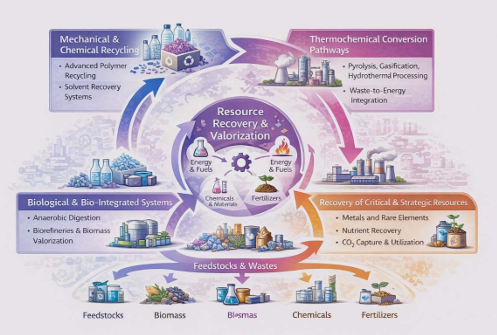
Figure 3 depicts the transformation of feedstocks and waste streams into valuable outputs through mechanical and chemical recycling, thermochemical conversion, biological and bio-integrated systems, and recovery of critical resources. Arrows and loops illustrate circularity and the flow of materials into energy, chemicals, and fertilizers, highlighting integrated valorization across multiple technological pathways.
Systems-level circular engineering: Systems-level circular engineering focuses on integrating processes, energy, materials, and digital technologies across industrial systems to achieve resilient, low-carbon, and resource-efficient production networks1. This approach moves beyond isolated process optimization to encompass closed-loop material flows, carbon management, smart manufacturing, and renewable energy integration, creating industrial ecosystems that maximize resource use and reduce emissions2. By applying circular economy principles at the system scale, chemical engineers can link production, energy, and supply chains effectively1.
Closed-loop systems and material flow analysis: Closed-loop systems maintain materials within productive cycles, minimizing waste and promoting sustainable resource management22. Material flow analysis (MFA) quantifies stocks and flows of materials, identifies losses, and guides process integration across sectors23. Integrating closed-loop thinking with circular supply chains enables efficient recovery, reuse, or recycling of resources across production stages and interlinked industrial networks2. Together, these strategies support long-term sustainability by keeping products, by-products, and wastes within productive cycles22.
Carbon management and CCUS integration: Effective carbon management is essential for systems-level circular engineering24. Carbon capture, utilization, and storage (CCUS) allows CO2 to be captured and converted into valuable chemicals or fuels, closing the carbon loop25. Advanced CO2 utilization pathways, including electrochemical conversion, integrate carbon into the production of intermediates such as formate26. Coupled with process-level integration, these technologies optimize energy and material flows while reducing greenhouse gas emissions24.
Digitalization and smart manufacturing: Digitalization enables real-time monitoring, predictive optimization, and enhanced resource efficiency2. Industry 5.0 technologies, including AI, IoT, and digital twins, allow interconnected production environments that reduce waste and improve performance2,23. Smart manufacturing leverages these tools to optimize energy and material use, implement adaptive control, and maintain traceability across supply chains, ensuring that circularity objectives are met efficiently2.
Renewable feedstocks and energy integration: Integrating renewable feedstocks and energy sources reduces dependence on fossil fuels and supports circular production systems1. Electrification of processes using renewable electricity, alongside green hydrogen and bio-based feedstocks, enables energy and materials to flow within closed-loop systems2. Coupled with smart manufacturing and CCUS, renewable integration ensures industrial systems remain resilient, low-carbon, and aligned with circular economy principles (Table 1)1.
| Table 1: | Key strategies and technologies for systems-level circular engineering | |||
| Components | Key strategies | Technologies | Circular economy contribution |
| Closed-loop systems and material flow analysis |
Material recirculation, waste minimization |
Material flow analysis (MFA), circular supply chains |
Keeps materials in productive cycles, reduces waste, enhances resource efficiency |
| Carbon management and CCUS integration |
CO2 capture, utilization, and storage |
Electrochemical conversion, CCUS, Carbon loop integration |
Converts emissions into feedstocks, closes carbon loops, reduces greenhouse gases |
| Digitalization and smart manufacturing |
Real-time monitoring, process optimization |
AI, IoT, Digital Twins, Blockchain |
Optimizes energy and material use, enhances traceability, supports predictive maintenance |
| Renewable feedstocks and energy integration |
Process electrification, bio-based feedstocks |
Green hydrogen, renewable electricity, biomass |
Reduces fossil dependency, enables low-carbon operations, integrates energy and material flows |
| Table 2: | Core environmental and economic evaluation frameworks for circular chemical engineering systems | |||
| Framework | Primary purpose | Key metrics | Role in circular engineering | Reference |
| Life Cycle | Quantifies environmental | GWP, energy | Identifies environmental | Aleisa and Heijungs27 |
| Assessment (LCA) | impacts across life cycle stages | demand, water use | hotspots and compares recovery pathway | and Hernández et al.28 |
| Techno-Economic Analysis (TEA) | Evaluates economic feasibility and scalability | CAPEX, OPEX, NPV | Assesses commercial viability of recycling and conversion technologies | Hernández et al.28 and Afzal et al.29 |
| Integrated LCA-TEA | Balances environmental and economic performance | Cost-arbon trade-offs | Supports optimized design and scale-up decisions | Rahman1 and Rejeb et al.2 |
| Circularity Metrics | Measures material loop performance | Recovery rate, circularity index | Evaluates effectiveness of closed-loop systems | Rahman1 |
Environmental and economic assessment: Evaluating the sustainability of circular engineering strategies requires integrated assessment frameworks that capture both environmental and economic dimensions. Life Cycle Assessment (LCA) quantifies environmental impacts across the full life cycle of a product or process, from resource extraction to end-of-life, while Techno-Economic Analysis (TEA) assesses the economic feasibility of technologies and process configurations1. Together, these tools provide a rigorous basis for identifying sustainable and economically viable circular engineering solutions (Table 2)2.
Life cycle assessment (LCA): A LCA is essential for identifying environmental hotspots and quantifying the benefits of circular approaches, such as recycling, reuse, and energy recovery27. For example, studies on chemical recycling and upcycling of mixed plastic waste show that LCA helps optimize process selection to reduce greenhouse gas emissions, energy consumption, and other environmental burdens28. By integrating LCA in early design stages, chemical engineers can ensure that circular interventions achieve net environmental improvements rather than shifting impacts to other life-cycle stages29.
Techno-economic analysis (TEA): The TEA complements LCA by evaluating economic performance, including capital expenditures, operating costs, and potential revenues. Recent TEA studies of mixed plastic waste gasification for methanol and hydrogen production demonstrate how economic feasibility depends on factors such as scale, feedstock price, and process efficiency29. When paired with LCA, TEA provides a comprehensive picture of sustainability, helping decision-makers balance cost and environmental performance while prioritizing scalable solutions28.
Integrated assessment and circularity metrics: Integrated LCA-TEA frameworks support evidence-based decision-making by quantifying environmental, economic, and circularity performance simultaneously2. Metrics such as material circularity, energy efficiency, and resource recovery ratios allow for comparative evaluation of alternative designs and technologies, ensuring that circular economy interventions deliver meaningful sustainability gains1. Such frameworks also facilitate scenario analysis to explore the effects of policy incentives, technological improvements, and market conditions on both environmental and economic outcomes27.
Trade-offs between environmental impact, cost, and scalability: Circular engineering often involves trade-offs, where improvements in one dimension may lead to increased impacts or costs elsewhere. A LCA may reveal that certain recycling pathways reduce carbon emissions but increase energy demand or resource consumption, while TEA may indicate that technologies are only cost-effective at large scales28,29. By combining LCA, TEA, and circularity metrics, engineers can identify optimal pathways that balance environmental benefits, economic viability, and scalability, supporting sustainable, circular production systems in chemical engineering1,2.
The LCA, Life Cycle Assessment; TEA, Techno-Economic Analysis; GWP, Global Warming Potential; CAPEX, Capital Expenditure; OPEX, Operating Expenditure; NPV, Net Present Value. Circularity metrics refer to indicators that quantify material recovery efficiency, resource recirculation, and closed-loop system performance.
CHALLENGES, POLICY INSTRUMENTS, AND FUTURE RESEARCH DIRECTIONS
The transition from linear production systems to circular engineering models remains constrained by technical, economic, and systemic barriers. A persistent technical challenge is feedstock variability, particularly in plastic and mixed waste streams, where inconsistent composition and contamination affect process efficiency, catalyst stability, and product quality30. At scale, the integration of recycling, conversion, and recovery technologies requires coordinated material and energy flows, yet circular systems often struggle with operational complexity and lifecycle trade-offs that demand holistic systems evaluation31. Moreover, the broad and sometimes inconsistent conceptualization of the circular economy complicates implementation, as differing definitions influence design priorities and performance metrics32.
Policy instruments play a decisive role in accelerating circular adoption. Regulatory measures such as carbon pricing create economic incentives that shift investment toward lower-carbon and resource-efficient technologies33. By internalizing environmental externalities, such instruments enhance the competitiveness of recycling and carbon utilization pathways relative to conventional fossil-based production. However, effective policy must align environmental objectives with industrial feasibility, ensuring that lifecycle impacts are genuinely reduced rather than displaced across value chains31. Market and supply chain limitations further influence circular deployment. Recycling systems often face high capital costs, volatile feedstock supply, and uncertain demand for secondary materials, constraining economic scalability30. In addition, ambiguous circularity metrics and fragmented standards can hinder coordinated supply chain redesign32. Addressing these constraints requires integrated lifecycle thinking and robust assessment frameworks to balance environmental and economic objectives.
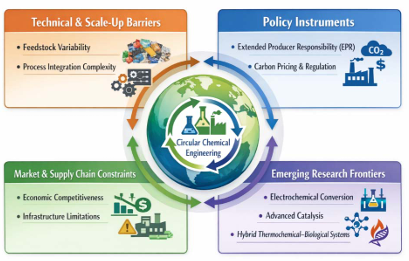
Emerging research directions provide pathways to overcome these barriers. Electrochemical CO2 conversion represents a promising route to couple renewable electricity with carbon valorization, although challenges remain in catalyst selectivity, durability, and reactor scale-up34. Advances in catalytic CO2 transformation and integrated life cycle evaluation highlight opportunities to align carbon utilization technologies with sustainability goals35-40. Continued progress in catalysis, systems integration, and policy alignment will be essential to enable scalable circular chemical engineering systems that are environmentally sound and economically viable. Figure 4 illustrates the main barriers, enabling policy instruments, and emerging research directions in circular chemical engineering.
CONCLUSION
Circular engineering in chemical processes offers a transformative pathway toward sustainable production, waste reduction, and resource recovery. By integrating principles of circular design, process optimization, resource valorization, and systems-level strategies, industries can minimize environmental impacts while improving economic efficiency. Despite significant progress, challenges remain in feedstock variability, process integration, policy alignment, and supply chain coordination. Emerging technologies such as electrochemical conversion, advanced catalysis, and hybrid thermochemical biological systems present promising opportunities to overcome these barriers and enhance circularity. Moving forward, the combined implementation of innovative process technologies, supportive policy frameworks, and coordinated industrial strategies will be critical to realize scalable, resilient, and economically viable circular chemical engineering systems that contribute to sustainable development and climate mitigation objectives.
|
SIGNIFICANCE STATEMENT
This study provides valuable insights into the relationship between the investigated variables and their potential implications for clinical practice and future research. The findings contribute to the existing body of knowledge by identifying key patterns and outcomes that may support evidence-based decision-making. These results also highlight areas requiring further investigation to improve disease management and patient care.
ACKNOWLEDGMENT
We thank all the researchers who contributed to the success of this research work.
REFERENCES
- Rahman, A., 2025. Circular economy approaches in chemical engineering: Redefining waste as resource. J. Adv. Chem. Eng., 15.
- Rejeb, A., K. Rejeb, J.G. Keogh and E. Süle, 2025. When industry 5.0 meets the circular economy: A systematic literature review. Circ. Econ. Sustainability, 5: 2621-2652.
- Ruiz-Mercado, G.J., 2024. Designing a safer circular economy of chemicals. Clean Technol. Environ. Policy, 26: 2415-2417.
- Bharadwaj, A.V.S.L.S., R.R. Nayak, J. Koteswararao, C. Sampath, B. Gaddala, B.G. Pawar and N.K. Gupta, 2025. Environmental life-cycle assessment and green principles in process intensification: A review of novel catalysts from solid waste. Chem. Eng. Process. Process Intensif., 211.
- Geetha, R., 2025. Circular economy through integrated industrial ecology: Innovations in resource recovery and process re-design. Biotechnol. Notes, 6: 245-259.
- Munonye, W.C., G.O. Ajonye and O.A. Akinloye, 2025. Industrial symbiosis in circular economies through policy and practice for waste to resource innovation. Discover Sustainability, 6.
- Anwar, M., M.E. Konnova and S. Dastgir, 2025. Circular plastic economy for sustainable development: Current advances and future perspectives. RSC Sustainability, 3: 3724-3840.
- Osman, A.I., M. Nasr, C.O. Aniagor, M. Farghali and M.M. Huang et al., 2025. Synergistic technologies for a circular economy: Upcycling waste plastics and biomass. Front. Chem. Sci. Eng., 19.
- Lee, J. and A. Marrocchi, 2024. Advances in green chemistry and engineering. Sci. Rep., 14.
- Abubakar, M.Y., P. Reuben, O.A. Titilayo, A.B. Adam and R. Shamsuddeen, 2024. Sustainable chemical process design: Recent advances in sustainable chemical process design, process intensification and life cycle assessment.: A review. Int. Res. J. Chem., 44: 11-21.
- Muster-Slawitsch, B., 2025. Process intensification for circular economy. Chem. Eng. Process. Process Intensif., 208.
- Peti, D., J. Dobránsky and P. Michalík, 2025. Recent advances in polymer recycling: A review of chemical and biological processes for sustainable solutions. Polymers, 17.
- Pinheiro, M.N.C. and L. Symochko, 2025. Biosustainability and waste valorization-advancing the circular bioeconomy paradigm. Sustainability, 17.
- Cucciniello, R. and D. Cespi, 2018. Recycling within the chemical industry: The circular economy era. Recycling, 3.
- Simioni, F.J., J.F. Soares, J. de Almeida do Rosário, L.G. Sell and E. Bertol et al., 2024. Industrial symbiosis and circular economy practices towards sustainability in forest-based clusters: Case studies in Southern Brazil. Sustainability, 16.
- Magson, J., T.G.L. Chan, A. Mohammed and K. Ward, 2024. Towards flexible large-scale, environmentally sustainable methanol and ammonia co-production using industrial symbiosis. RSC Sustainability, 3: 1157-1169.
- Srivastava, R.K., P.K. Sarangi, A.K. Singh, A. Parveen and U.K. Sahoo et al., 2025. Innovative recycling strategies for non-recycled plastics: Advancing the circular economy for a sustainable future. RSC Sustainability, 3: 5433-5458.
- Alabi, O.O., T.O. Akande, O.J. Gbadeyan and N. Deenadayalu, 2025. Advanced technologies for plastic waste recycling: Examine recent developments in plastic waste recycling technologies. RSC Adv., 15: 40541-40557.
- Wada, O.Z., A.O. Ige, B.I. Egbewole and D.B. Olawade, 2026. Circular economy from wastewater resource recovery: A review of recent advances and global disparities. Sustainable Chem. One World, 9.
- Hamzat, A.K., M. Shafinur Murad, B. Subeshan, R. Asmatulu and E. Asmatulu, 2025. Rare earth element recycling: A review on sustainable solutions and impacts on semiconductor and chip industries. J. Mater. Cycles Waste Manage., 27: 3009-3032.
- Singh, S., N. Sivaram, B. Nath, N.A. Khan, J. Singh and P.C. Ramamurthy, 2024. Metal organic frameworks for wastewater treatment, renewable energy and circular economy contributions. npj Clean Water, 7.
- Kara, S., M. Hauschild, J. Sutherland and T. McAloone, 2022. Closed-loop systems to circular economy: A pathway to environmental sustainability? CIRP Anal., 71: 505-528.
- Payer, R.C., O.L.G. Quelhas and N.C.R. Bergiante, 2024. Framework to supporting monitoring the circular economy in the context of industry 5.0: A proposal considering circularity indicators, digital transformation, and sustainability. J. Cleaner Prod., 466.
- Baskaran, D. and H.S. Byun, 2025. Future-proofing CO2 mitigation towards a circular economy: A systematic review on process integration and advanced tools. Environ. Sci. Ecotechnol., 26.
- Pinto, A.S.S., N. Gulpinar, F. Liu, E. Gibson, L. Fuller and P. Souter, 2025. Carbon capture and utilization for sustainable supply chain design of intermediate chemicals: The formate factory. ACS Sustainable Resour. Manage., 2: 733-743.
- Tayyab, M., M. Dreis, D. Blaudszun, K. Pellumbi and U. Nzotcha et al., 2025. Closing the carbon cycle: Challenges and opportunities of CO2 electrolyser designs in light of cross-industrial CO2 source-sink matching in the European landscape. Energy Environ. Sci., 18: 6854-6873.
- Aleisa, E. and R. Heijungs, 2022. Leveraging life cycle assessment to better promote the circular economy: A first step using the concept of opportunity cost. Sustainability, 14.
- Hernández, B., Y. Luo, D. Vlachos and M. Ierapetritou, 2026. Techno-economic and life cycle assessment of chemical recycling and upcycling of mixed plastics waste containing poly-vinyl-chloride. ACS Sustainable Chem. Eng., 14: 1017-1031.
- Afzal, S., A. Singh, S.R. Nicholson, T. Uekert and J.S. DesVeaux et al., 2023. Techno-economic analysis and life cycle assessment of mixed plastic waste gasification for production of methanol and hydrogen. Green Chem., 25: 5068-5085.
- Ragaert, K., L. Delva and K. van Geem, 2017. Mechanical and chemical recycling of solid plastic waste. Waste Manage., 69: 24-58.
- Ghisellini, P., C. Cialani and S. Ulgiati, 2016. A review on circular economy: The expected transition to a balanced interplay of environmental and economic systems. J. Cleaner Prod., 114: 11-32.
- Kirchherr, J., D. Reike and M. Hekkert, 2017. Conceptualizing the circular economy: An analysis of 114 definitions. Resour. Conserv. Recycl., 127: 221-232.
- World Bank, 2023. State and Trends of Carbon Pricing 2023. World Bank, Washington, DC., USA, ISBN: 978-1-4648-2006-9, Pages: 77.
- Nitopi, S., E. Bertheussen, S.B. Scott, X. Liu and A.K. Engstfeld et al., 2019. Progress and perspectives of electrochemical CO2 reduction on copper in aqueous electrolyte. Chem. Rev., 119: 7610-7672.
- Artz, J., T.E. Müller, K. Thenert, J. Kleinekorte and R. Meys et al., 2017. Sustainable conversion of carbon dioxide: An integrated review of catalysis and life cycle assessment. Chem. Rev., 118: 434-504.
- Paul-Okore, R.O., C.J. Attah, A.N. Godwin, Y.A. Showemimo, M.A. Abah and M.A. Oladosu, 2026. Sustainable bioenergy: A review of biomass conversion technologies and their environmental impacts. Int. J. Res. Manage. Sci. Eng., 3: 32-43.
- Odimgbe, E.I., M.A. Oladosu, M.A. Abah, J. Ezeani, A.O. Gbadebo and C.S. Amadi, 2026. Advances in nanomaterials for chemistry-based sustainable energy technologies: Design strategies, performance and environmental considerations: Review article. Sci. Arch., 7: 163-172.
- Abah, M.A., R.O. Alabi, M.A. Oladosu, O.D. Agida and N.J. Nnaemek, 2025. Sustainable energy production from mine waste: A review of opportunities and challenges. Environ. Rep., 7: 240-245.
- Aduwa, S.I., M.A. Abah, M.O. Abimbola, O.D. Agida and C.J. Attah, 2025. Petroleum geology of unconventional reservoirs: A review of current research. Environ. Rep., 7: 190-198.
- Abah, M.A., R.O. Paul-Okore, M.A. Oladosu and O.D. Agida, 2025. Comparative study on green hydrogen production via solar vs wind electrolysis. Sci. Lett., 6: 28-36.
How to Cite this paper?
APA-7 Style
Vaekosen,
B.C., Chukwurah,
K.F., Ibrahim,
I., Adondua,
M.A., Abimbola,
M.O. (2026). Advancing Circular Economy in Chemical Engineering: Strategies for Waste Reduction and Resource Recovery. Science International, 14(1), 88-99. https://doi.org/10.17311/sciintl.2026.88.99
ACS Style
Vaekosen,
B.C.; Chukwurah,
K.F.; Ibrahim,
I.; Adondua,
M.A.; Abimbola,
M.O. Advancing Circular Economy in Chemical Engineering: Strategies for Waste Reduction and Resource Recovery. Sci. Int 2026, 14, 88-99. https://doi.org/10.17311/sciintl.2026.88.99
AMA Style
Vaekosen
BC, Chukwurah
KF, Ibrahim
I, Adondua
MA, Abimbola
MO. Advancing Circular Economy in Chemical Engineering: Strategies for Waste Reduction and Resource Recovery. Science International. 2026; 14(1): 88-99. https://doi.org/10.17311/sciintl.2026.88.99
Chicago/Turabian Style
Vaekosen, Brighotaye, Cheery, Kenechukwu Fortunate Chukwurah, Ibrahim Ibrahim, Moses Abah Adondua, and Micheal Oladosu Abimbola.
2026. "Advancing Circular Economy in Chemical Engineering: Strategies for Waste Reduction and Resource Recovery" Science International 14, no. 1: 88-99. https://doi.org/10.17311/sciintl.2026.88.99

This work is licensed under a Creative Commons Attribution 4.0 International License.
