
FTA Cards in Molecular Biology: Advancements in Sample Stability and Processing
-
Zainab Aliyu Muhammad
Faculty of Science and Computing, Baba-Ahmed University, Kano, Nigeria
Tijjani Sabiu ImamFaculty of Life Sciences, Bayero University, Kano, Nigeria
Kabiru Abubakar MusaFaculty of Basic Medical Sciences, Bayero University, Kano, Nigeria
Zainab Muhammad Sani

Faculty of Life Sciences, Bayero University, Kano, Nigeria
| Received 25 Mar, 2026 |
Accepted 01 Aug, 2026 |
Published 24 Aug, 2026 |
Flinders Technology Associates (FTA) is a recently developed technology that reduces the critical steps in nucleic acid extraction and allows convenient long-term storage of biological specimens. This review focuses on sample stability, processing efficiency and downstream molecular analysis. It highlights the benefits, limitations and future perspectives of integrating FTA cards into diverse fields. FTA cards are chemically treated cellulose matrices designed to lyse cells, inactivate contaminants and stabilize nucleic acids for long-term storage. Their various formats provide flexibility for different sample types and molecular applications while maintaining sample integrity and simplifying downstream analyses.
| Copyright © 2026 Muhammad et al. This is an open-access article distributed under the Creative Commons Attribution License, which permits unrestricted use, distribution, and reproduction in any medium, provided the original work is properly cited. |
INTRODUCTION
In molecular research, sample preservation is crucial, as it aids in maintaining the integrity of biomolecules (nucleic acids and proteins) for accurate and reproducible downstream analyses1,2. It is very complex as such has many challenges, some of which are; rapid protein and nucleic acids degradation due to action of nucleases, fluctuation in environmental factors such as temperature, humidity and light, nature of sample transport and storage, improper handling that may result in cross-contamination, sample volume and accessibility, specificity in preservation, biosafety and regulatory constraints and as well it is very costly. The aforementioned challenges can be addressed through any of the following: the use of FTA cards and similar matrix-based systems to inactivate and stabilize biomolecules such DNA, develop stabilizing reagents can be used to stabilize RNA, employ the lyophilization (freeze-drying) method or create portable cold-chain alternatives like solar-powered freezers2.
Flinders Technology Associates (FTA) cards were introduced during the 1980s as a practical solution for the collection, transport and preservation of biological samples1,3. The technology enables nucleic acid stabilization at ambient temperature and supports direct molecular analyses, thereby reducing dependence on conventional extraction and storage procedures. Owing to these advantages, FTA cards have found applications in forensic science, clinical diagnostics, agriculture and molecular research1,3-5.
|
Advances in molecular diagnostics, genomics and next-generation sequencing have increased the demand for high-quality nucleic acids suitable for downstream analyses4. Consequently, effective sample preservation has become an important aspect of modern molecular research4,6. Conventional preservation methods often depend on refrigeration, cryopreservation and specialized storage facilities, which may be costly and difficult to maintain7,8. These limitations have encouraged the adoption of alternative preservation technologies such as FTA cards, particularly in settings where cold-chain infrastructure is unavailable. This study aims to evaluate the role of FTA cards in molecular biology by examining their advancements in sample stabilization, nucleic acid preservation, and streamlined processing, with particular emphasis on improving sample integrity, transport efficiency, and downstream molecular analysis accuracy.
FTA CARDS: COMPOSITION AND MECHANISM
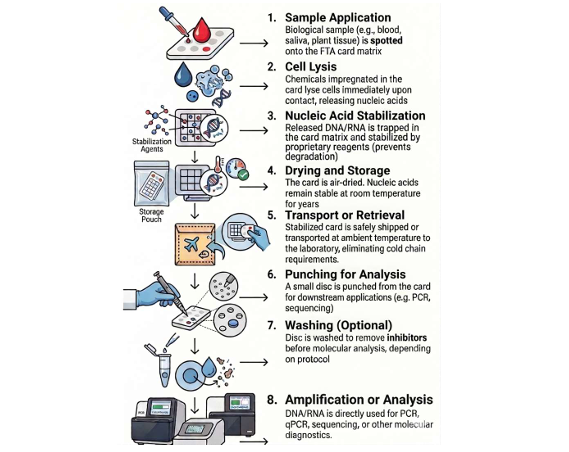
The FTA cards consist of chemically treated cellulose matrices specifically designed to preserve nucleic acids1,9. Upon application of a biological sample, the embedded reagents facilitate cell disruption, protein denaturation and inhibition of nucleases, thereby protecting DNA and RNA from degradation10. The preserved nucleic acids may subsequently be recovered for direct amplification or extraction-based molecular analyses9,10. Different card formats are available to accommodate various sample types and analytical requirements10-12. Samples of blood, tissue swaps, allantoic fluids, and microbial cultures have been sampled and preserved using such cards12. Blood collection requires just one or two drops of blood onto an FTA card12 as presented in Fig. 1. For buccal cell collection, an EasiCollect device is used which allows a uniform cell collection and stability on to the surface of an Indicating FTA card for subsequent DNA capture. These cards are mainly employed for colourless samples (buccal cells and saliva), as such, are formulated to transform from pink or purple to white when a sample is applied, making it simplest in sample transfer verification as well as sample position location for downstream processing6.
| Table 1: | Features and applications of some notable FTA cards1,3,11,14,15 | |||
| Type | Features | Nature of Action | Application |
| Whatman FTA classic card | Chemically treated matrix that lyses cells and preserves DNA on contact | Stores biological samples (blood, buccal swabs, cultured cells and tissue samples) for long periods | Forensic DNA analysis, genotyping and biobanking |
| Whatman FTA elute card | Enables fast nucleic acid extraction with the addition of water and heat | Designed for easy elution of nucleic acids by skipping purification stages | PCR, RT-PCR and analyses where quick nucleic acid recovery is required |
| Whatman FTA indicating card | Contains a pink matrix that turns white upon contact with the sample | Used for visual confirmation of samples | Field sample collection where visual visual verification is required |
| Whatman FTA PlantSaver Card | It has a larger sample area with a protective flap to prevent contamination | Designed for preserving DNA of plant tissue | Plant genotyping, disease diagnostics and germplasm conservation |
| Whatman Gene Catcher Card | It has an optimized chemical composition to enable the stabilization nucleic acids | Designed for RNA preservation in addition to DNA | Transcriptomic studies, viral RNA detection and RNA-based diagnostics |
| FTA micro card | Compact format for use in constrained sampling situations | Used for small-scale DNA collection with minimal sample volume | Forensic applications, neonatal screening and microbe research |
| FTA DMPK cards (A, B and C) | Specialized chemical treatments for different compounds recovery profiles | Used in pharmacokinetic and drug metabolism studies | Clinical research, drug monitoring and bioanalysis |
The FTA cards are produced in both classic and indicating formats (Table 1). While classic cards are commonly used for blood samples, indicating cards contain colour-changing dyes that facilitate visualization of transparent specimens such as saliva and buccal cells10,13. The availability of different card configurations allows users to select formats suitable for specific sampling requirements13. Their ability to preserve nucleic acids at room temperature makes them particularly useful for field studies and resource-limited environments2,3,9.
As precautionary measures are applicable to each research and sampling tool, the same as FTA cards before and after use, it is recommended that unused FTA cards should be stored at room temperature (20-24°C, 68-75°F) in a zip-sealed (zip-lock) plastic bag, and cards require protection against light to ensure the safety of chemicals from damage14. Also, it is important to wear gloves while handling FTA cards to avoid contamination and as well the use of fresh tissues to ensure the quality of nucleic acids is recommended6.
SAMPLE STABILITY AND STORAGE USING FTA CARD
In recent years, the commonest methods for the preservation and storage of DNA and RNA include frozen storage, which ensures the highest efficiency when consistently maintained but is logistically demanding. Ethanol is also used in preserving nucleic acids, which offers a short-term solution due to evaporation risks and poor RNA protection. Another method employed in nucleic acid preservation is the silica gel/dried tissue method, which is basically used in the field for DNA; however, it is not effective in preserving RNA8. Although all the earlier mentioned methods exhibit certain level of effectiveness in the preservation of nucleic acids, their specifications and limitations resulted in the continuous development of new, easier and cost-effective methods. The FTA cards have been reported to have an exceptional sample stability and storage efficiency, thus, are regarded as an excellent choice for nucleic acid preservation. This is due to the fact that during application, embedded chemicals in the card quickly lyse cells, effectively binding and stabilizing DNA or RNA by preventing enzymatic degradation, oxidation and microbial growth2. This allows the nucleic acids to remain intact and analyzable for years at room temperature, without the need for refrigeration or freezing. However, with regards to storage efficiency, FTA cards are compact, lightweight and require minimal storage space compared to the traditional methods that mostly rely on bulky cryogenic freezers or liquid nitrogen tanks14. The use of these cards makes large-scale studies highly manageable and cost-effective, as multiple samples can be stored in a single binder. This method also simplifies sample cataloging, easy retrieval and enables quick access and streamlined workflows in both laboratory and field conditions8.
The performance of FTA cards under varying conditions is critical for maintaining DNA integrity for field or resource-limited settings. They are designed to be highly stable across a range of temperatures, for instance, at temperatures of 20-25°C16, DNA storage stands for years with minimal degradation. Studies have revealed that at elevated temperatures 37-45°C, they preserve DNA for weeks; however, prolonged exposure (beyond six months) may lead to a slight reduction in yield or quality. On the other hand, exposure to temperatures above 50°C for longer periods interacts with the chemical matrix and reduces the quality of preserved DNA. Cold temperatures (below zero) are the most preferred conditions for FTA utilization as they tend to enhance DNA preservation by minimizing residual enzymatic activity or environmental degradation15. Time is another criterion for assessing an FTA card's performance, which is categorized into short-term, medium-term and long-term storage. Short-term storage covers days to few weeks, where DNA remains highly stable and can be recovered with excellent yield and purity due to inhibition of microbial growth and nuclease activity by the card’s matrix. In medium-term storage, the stability of the DNA is maintained in consistency with the PCR amplifiability and minimal degradation which requires a dry and dark environment4. Furthermore, previous studies have revealed successful PCR amplification from DNA spotted on FTA cards preserved for over a decade. Another interesting factors for determining FTA card performance are humidity and environmental stress. The storage potential of FTA cards can be affected by high humidity and insufficient storage practices (including direct exposure to sunlight and frequent temperature fluctuations). Excess moisture may initiate microbial growth or compromise the card’s chemical constituent, while direct exposure to solar or UV radiation can dissociate nucleic acids. These cards are ideal for field sampling and situations exempting cold-chain logistics, due to their ability to preserve nucleic acids under proper storage conditions1.
CASE STUDIES DEMONSTRATING LONG-TERM STORAGE SUCCESS OF FTA CARDS
The FTA cards have emerged as a revolutionary tool for the collection, transport and long-term storage of DNA. Numerous studies from diverse disciplines have highlighted the versatility and effectiveness of FTA cards for DNA preservation over extended periods under varying environmental conditions across a wide range of applications. In forensic science, for example, DNA samples stored for over 16 years at room temperature yielded reliable STR profiles essential for solving cold cases3. Similarly, a study on malaria surveillance across Sub-Saharan Africa confirmed the viability of Plasmodium species fixed on blood samples stored for 7 years on these cards10. In the realm of biodiversity and plant genetics, researchers have successfully extracted high quality DNA from plant leaf punches stored on FTA cards for more than a decade, which help in conservation and barcoding efforts. Biobanks and population studies have also demonstrated that DNA from FTA-stored cheek swabs and blood spots remain amplifiable after 8-10 years, supporting their use in long-term genomic research2. Collectively, the aforementioned cases affirm the reliability of FTA cards as long-term storage medium, offering durable, low-maintenance preservation across a wide range of biological disciplines8.
APPLICATION OF FTA TECHNOLOGIES IN MOLECULAR RESEARCH
Filter paper-based preservation systems have long been utilized in molecular biology for sample collection and nucleic acid storage17. Among these systems, FTA cards provide a convenient and economical approach by combining sample collection, preservation and transport within a single platform5. Their compatibility with multiple downstream molecular techniques, including PCR, RT-PCR, SNP analysis and sequencing, has contributed to their widespread adoption in research and forensic laboratories1,10.
Application genomics and genetic analysis: The FTA cards are employed for collection, stabilization and storage of nucleic acids which can be subjected to several genetic processes that include genotyping, sequencing and SNP. These processes are widely used in the fields of population genetics, forensic sciences and clinical genomics. Studies have demonstrated successful use of FTA cards for whole-genome amplification and next-generation sequencing (NGS) from dried blood spots and buccal cells6. These cards have extended biobanking of genetic material and large-scale epidemiological studies where thousands of samples can be easily archived for future use15. The ability to preserve genetic material at ambient conditions while maintaining compatibility with modern tools underscores the value of FTA cards in advancing genomic research and diagnostics2.
Application pathogen detection and epidemiology: The ability of FTA cards to preserve nucleic acids makes them suitable for field collection and transport during pathogen detection and epidemiological surveillance. They have been effectively employed in the detection of viral, bacterial and parasitic pathogens from blood, saliva and tissues samples obtained from both human and animal populations. For instance, pathogens like HIV, Zika virus, Plasmodium species and Mycobacterium tuberculosis were detected through direct PCR or RT-PCR from the card punches without complete DNA/RNA purification16. In epidemiological studies, they support large-scale sample collection in remote areas for molecular survey of disease outbreaks and as well tracks antimicrobial resistance, as such are valuable tools in global health monitoring and early outbreak response15.
Application forensic and conservation biology: The preservative nature of FTA cards for nucleic acids isolated from trace samples have proven highly valuable in forensic science and conservation biology. The FTA cards are utilized for the collection and storage of biological evidence (blood, buccal cells and tissue) retrieved from crime scenes or individuals for subsequent profiling that can assist in identity verification and other criminal investigations in the near future. They can be particularly useful in mass disaster identification and low-resource forensic settings. On the other hand, FTA cards in conservation biology, facilitate non-invasive sampling of endangered species through collection of hair, feces or saliva which enables genetic monitoring, population studies and biodiversity assessments. The stability and portability of FTA cards enable field researchers to utilize them for wildlife genetics and species conservation studies6.
Application agricultural and environmental sciences: FTA cards are increasingly in the storage and preservation of genetic materials from plants, soil microbes and other important environmental samples. Genetic material from plant components (tissues, seeds or sap) are extracted and stored for future genotyping, pathogen detection and trait marker analysis under fluctuating field conditions18,19. In early diagnosis and disease management in crop systems, these cards have been reported to aid in detecting plant viruses such as cassava mosaic and banana bunchy top via PCR-based methods15. However, in environmental science, they enable extensive DNA storage from soil, water and air samples for biodiversity assessments, microbial community profiling and environmental monitoring. The capability makes them an excellent choice for ecological surveys, biosecurity and sustainable agricultural practices in diverse environments1.
Application in human diagnosis: Studies have proven that blood samples were stored successfully onto FTA card for further diagnostic purposes and crime investigations12. According to da Cunha-Santos1, RNA was isolated from peripheral blood collected on FTA Classic Cards (Whatman) from 59 individuals and analyzed using reverse transcription and Real-Time PCR reactions which confirms the reliability of FTA card for blood sample collection from RNA analysis. A study by Sahajpal et al.12 confirms the success rate of multiplex PCR with the generation of complete STR profiles from blood samples stored onto FTA card. Another research proved that DNA yield and quality from blood samples stored on FTA cards applies to short tandem repeat (STR) profiles from previously processed FTA card pieces that had been stored at 4°C for up to one year which indicate preciousness of FTA card samples in terms of storage for future analysis even though it contains the extracted DNA on it1. According to Green et al.17, an aliquot of 75 μL of the collected blood was applied to the FTA card, to investigate whether FTA card can serve as sampling and preservative tool for emergency identification process and the result shows that DNA profile can be obtained from postmortem tissue on FTA card especially tissues from inner organs. The FTA card serves as a tool for biobanking cytological samples in the molecular era. Studies from human samples have proven the application of FTA card as a tool for preserving human samples meant for diagnosis. It is applicable to mutational analysis from human lung tumor and cancer cell lines. It also serves as a tool in collecting samples from patients with leishmaniasis as well as for women cervical cancer screening6,8.
Application in plant sample preservation: Several studies have demonstrated the suitability of FTA cards for preserving plant genetic material1,18,20. Successful direct PCR amplification has been reported from numerous plant species without the need for conventional DNA extraction procedures. For example, investigations involving oil palm and maize samples confirmed that DNA stored on FTA cards remained suitable for subsequent molecular analyses18,19. Comparative studies have further shown that although DNA yields obtained from FTA cards may sometimes be lower than those produced by CTAB-based extraction methods, the recovered DNA is generally adequate for amplification, sequencing and population genetic studies20.
Application in microorganisms preservation: The increasing reliance on molecular approaches for microbial identification has created a need for reliable methods of nucleic acid preservation. The FTA cards have been evaluated for the storage of diverse bacterial species and have demonstrated effectiveness in maintaining DNA quality during long-term storage10. Studies involving several clinically important bacteria reported successful amplification of target genes and generation of molecular fingerprints after prolonged preservation on FTA cards, highlighting their usefulness in microbial surveillance and diagnostics10,15,21.
Research involving Campylobacter jejuni isolated from poultry demonstrated that DNA preserved on FTA cards remained suitable for PCR amplification and sequencing analyses22. Similar studies involving diarrheal pathogens and Mycobacterium avium subsp. paratuberculosis have shown that FTA cards facilitate sample preservation, transport and rapid molecular detection. These findings support the application of FTA technology in veterinary diagnostics, epidemiological surveillance and pathogen monitoring programs6,22.
The FTA cards have also proven valuable for fungal and viral investigations. Successful amplification and sequencing of DNA from fungal genera such as Aspergillus, Candida and Penicillium have been reported following storage on FTA matrices1,23. In virological studies, the cards have supported the preservation and detection of both RNA and DNA viruses, including mosquito-borne pathogens15,21. Their compatibility with next-generation sequencing and RT-PCR has further strengthened their role in disease surveillance, viral monitoring and outbreak investigations2,9,21.
SAMPLE PROCESSING AND WORKFLOW INTEGRATION
The FTA card technology simplifies sample processing and streamlines workload integration by combining sample collection, stabilization and storage into a single step. Once a biological specimen is applied and dried on the card, nucleic acids are preserved and pathogens are inactivated, reducing the need for cold-chain logistics and biosafety-level containment. In laboratory workflows, processing involves simple punches from the card, followed by rapid nucleic acid extraction protocols compatible with PCR and other molecular techniques. This minimizes sample handling time, reduces contamination risks and supports high-throughput processing. Additionally, FTA cards are easily integrated into existing diagnostic pipelines, making them ideal for both centralized labs and decentralized testing environments, where efficiency and consistency are essential1,2.
Extraction of DNA or RNA from FTA cards follow standardized steps that vary with respect to the card type, target nucleic acid and downstream application. For DNA, a small disc (2-3 mm) is punched from the dried sample area and typically washed with FTA purification reagent or TE buffer to remove inhibitors, followed by drying and incubation in nuclease-free water or buffer at 95°C to release DNA for direct use in PCR. However, during RNA extraction, the punch is placed in lysis buffer then processed using a standard RNA extraction kit, including phase separation, precipitation, washing and elution in RNase-free water5. These protocols are simple, efficient and suitable for integration into both lab-based and field diagnostics. Once the nucleic acids are extracted, they can be directly used in standard and real-time amplification processes. Additionally, with proper extraction and cleanup, the nucleic acids meet the quality and concentration requirements for library preparation in NGS analysis, thus, are suitable for genomic, transcriptomic and metagenomic applications3,16.
The FTA cards are ideal for large-scale diagnostic, forensic and research applications as such are well-suited for automation and high-throughput processing. Their standardized format allows easy handling by robotic liquid handlers and automated punchers, enabling consistent sample excision and transfer to multiwall plates. Automated nucleic acid extraction platforms can be adapted to process FTA card punches which streamlines workflows and minimize manual errors. Furthermore, the simplified sample prep reduces bottlenecks in high-volume research settings. The aforementioned features collectively support scalable and cost-effective integration of FTA cards into centralized labs and surveillance systems4,18.
ADVANTAGES AND LIMITATIONS
The use of FTA card technologies is accompanied with quite several advantages and disadvantages. The benefits of these cards include; long-term nucleic acid preservation, inactivation of pathogenic organisms, enables easy sample collection, suitable for a wide range of molecular techniques, reduces risk of sample contamination, and as well are portable and cost-effective. The use of these cards is limited to sample volume (the sample quantity is usually small), less effective for RNA preservation, inconsistencies during nucleic acid recovery, sample specific, mostly designed for one-time use and unsuitable for immediate on-card diagnostics1,4,6.
FUTURE PERSPECTIVES
Recent advancements in FTA card technologies are focusing on developing new formulations optimized for RNA stabilization that is reliable for the preservation of fragile RNA molecules for RT-PCR, transcriptomics and viral diagnostics at outdoor conditions. Some FTA cards have also been integrated with biosensor technologies (electrochemical and optical sensors) to enable direct on-site detection of nucleic acids or pathogens which substitutes complex and extensive laboratory processing. This technique enhances the use of the preserved nucleic acids in rapid diagnostics, environmental monitoring and global health surveillance, particularly in low-resource or remote settings1,4,6.
The FTA card technologies are increasingly tailored to support the initiation of decentralized and mobile molecular laboratories for easier sample collection, stabilization and analysis outdoors. More of such cards are engineered for improved nucleic acid preservation under variable conditions1,2.
Furthermore, the advancement of these cards is crucial for future paramedic preparedness and point-of-care diagnostics to enable rapid, room-temperature stabilization of both DNA and RNA for quick and efficient medical decisions in the case of crisis situations, pandemics and remote patient care3,8,15.
CONCLUSION
The FTA card technologies have been widely used in many molecular research applications for several specimens which have proven to be efficient in terms of storage and extraction of nucleic acids. The FTA cards have reshaped sample collection and processing in molecular biology by offering reliable preservation and transport of nucleic acids. Continued innovation will expand their utility across research and clinical applications, especially in low-resource and field environments.
SIGNIFICANCE STATEMENT
The FTA cards have transformed molecular research by enabling safe, simple and long-term preservation of nucleic acids at ambient conditions without the need for cold-chain systems. They improve accessibility in resource-limited and field settings, enhance biosafety through pathogen inactivation and maintain sample integrity for downstream analyses. Additionally, they simplify and streamline sample processing, reducing time, cost and technical complexity, thus, are reliable and scalable tools for modern molecular investigations.
REFERENCES
- da Cunha Santos, G., 2018. FTA cards for preservation of nucleic acids for molecular assays: A review on the use of cytologic/tissue samples. Arch. Pathol. Lab. Med., 142: 308-312.
- Fonseca, A.A., V.L. da Silva Gonçalves, A.A.S. Barbosa and M.F. Camargos, 2024. Use of FTA card for the detection of two RNA (CSFV and SV-A) and two DNA viruses (ASFV and SuHV-1) of importance in veterinary medicine. Braz. J. Microbiol., 55: 1961-1966.
- Davis, E.H., J.O. Velez, B.J. Russell, A.J. Basile, A.C. Brault and H.R. Hughes, 2022. Evaluation of Whatman FTA cards for the preservation of yellow fever virus RNA for use in molecular diagnostics. PLoS Negl. Trop. Dis., 12.
- Abosrer, F., G. Pezzoni, E. Brocchi, A. Castelli and S. Baselli et al., 2022. FTA cards as a rapid tool for collection and transport of infective samples: Experience with foot-and-mouth disease virus in Libya. Animals, 12.
- Cardona-Ospina, J.A., M.F. Villalba-Miranda, L.A. Palechor-Ocampo, L.I. Mancilla and J.C. Sepúlveda-Arias, 2019. A systematic review of FTA cards® as a tool for viral RNA preservation in fieldwork: Are they safe and effective? Preventive Vet. Med., 172.
- Elmrghni, S., 2024. DNA extraction from blood stored on FTA cards. Eur. J. Med. Health Res., 2: 4-8.
- Kiraz, N., Y. Oz, H. Aslan, Z. Erturan and B. Ener et al., 2015. Is the extraction by Whatman FTA filter matrix technology and sequencing of large ribosomal subunit D1-D2 region sufficient for identification of clinical fungi? Mycoses, 58: 588-597.
- Botnen, A.B., M.B. Bjørnsen, A. Alberdi, M.T.P. Gilbert and O. Aizpurua, 2023. A simplified protocol for DNA extraction from FTA cards for faecal microbiome studies. Heliyon, 9.
- Fynmore, N., R. Lühken, H. Maisch, T. Risch and S. Merz et al., 2021. Rapid assessment of West Nile virus circulation in a German zoo based on honey-baited FTA cards in combination with box gravid traps. Parasites Vectors, 14.
- Yue, N. and Z. Jia, 2021. Comparison between Whatman FTA Elute cards and conventional swab for the detection of pathogenic enteric bacteria using an RT-qPCR Assay. Can. J. Infect. Dis. Med. Microbiol., 2021.
- Krambrich, J., E. Bringeland, J.C. Hesson, T. Hoffman, Å. Lundkvist, J.F. Lindahl and J. Ling, 2022. Usage of FTA® classic cards for safe storage, shipment, and detection of arboviruses. Microorganisms, 10.
- Sahajpal, V., S. Rajput, T. Sharma, A. Sharma and M.K. Thakar, 2019. Development and evaluation of a novel DNA purification buffer and protocol for blood samples on FTA cards. Forensic Sci. Int.: Rep., 1.
- Serra, O., R. Frazzi, A. Perotti, L. Barusi and A. Buschini, 2018. Use of FTA® classic cards for epigenetic analysis of sperm DNA. BioTechniques, 64: 45-51.
- Yacouba, A., M. Congo, G.K. Dioma, H. Somlare, D. Coulidiaty, K. Ouattara and L. Sangare, 2020. Whatman FTA cards versus plasma specimens for the quantitation of HIV-1 RNA using two real-time PCR assays. Access Microbiol., 2.
- Manzi, S., L. Nelli, C. Fortuna, F. Severini and L. Toma et al., 2023. A modified BG-Sentinel trap equipped with FTA card as a novel tool for mosquito-borne disease surveillance: A field test for flavivirus detection. Sci. Rep., 13.
- Elnagar, A., T.C. Harder, S. Blome, M. Beer and B. Hoffmann, 2021. Optimizing release of nucleic acids of African swine fever virus and Influenza A virus from FTA cards. Int. J. Mol. Sci., 22.
- Green, H., A. Tillmar, G. Pettersson and K. Montelius, 2019. The use of FTA cards to acquire DNA profiles from postmortem cases. Int. J. Legal Med., 133: 1651-1657.
- Asri, N.A.S.M., A.A. Zulkifli, M. Razik Bin Midin and W.N.W. Hanafi, 2025. Microsatellite (mEgCIR3808) analysis in oil palm: An optimisation of a direct PCR-based using FTA card as a storage medium. Int. J. Integr. Eng., 16: 80-90.
- Shah, F.H., O. Rashid, A.J. Simons and A. Dunsdon, 1994. The utility of RAPD markers for the determination of genetic variation in oil palm (Elaeis guineensis). Theor. Appl. Genet., 89: 713-718.
- Siegel, C.S., F.O. Stevenson and E.A. Zimmer, 2017. Evaluation and comparison of FTA card and CTAB DNA extraction methods for non-agricultural taxa. Appl. Plant Sci., 5.
- Birnberg, L., S. Temmam, C. Aranda, F. Correa-Fiz and S. Talavera et al., 2020. Viromics on honey-baited FTA cards as a new tool for the detection of circulating viruses in mosquitoes. Viruses, 12.
- Sierra-Arguello, Y.M., O. Faulkner, G. Tellez, B.M. Hargis and V.P. do Nascimento, 2016. The use of FTA cards for transport and detection of gyr a mutation of Campylobacter jejuni from poultry. Poult. Sci., 95: 798-801.
- Lalani, T., M.D. Tisdale, J. Liu, I. Mitra and C. Philip et al., 2018. Comparison of stool collection and storage on Whatman FTA Elute cards versus frozen stool for enteropathogen detection using the TaqMan Array Card PCR assay. PLoS ONE, 13.
How to Cite this paper?
APA-7 Style
Muhammad, Z. A., Imam, T. S., Musa, K. A., & Sani, Z. M. (2026). FTA cards in molecular biology: Advancements in sample stability and processing. Science International, 14(1), 79–87. https://doi.org/10.17311/sciintl.2026.79.87
ACS Style
Muhammad, Z. A.; Imam, T. S.; Musa, K. A.; Sani, Z. M. FTA Cards in Molecular Biology: Advancements in Sample Stability and Processing. Sci. Int 2026, 14 (1), 79–87. https://doi.org/10.17311/sciintl.2026.79.87
AMA Style
Muhammad ZA, Imam TS, Musa KA, Sani ZM. FTA cards in molecular biology: advancements in sample stability and processing. Science International. 2026;14(1):79–87. doi:10.17311/sciintl.2026.79.87
Chicago/Turabian Style
Muhammad, Zainab Aliyu, Tijjani Sabiu Imam, Kabiru Abubakar Musa, and Zainab Muhammad Sani. 2026. “FTA Cards in Molecular Biology: Advancements in Sample Stability and Processing.” Science International 14 (1): 79–87. https://doi.org/10.17311/sciintl.2026.79.87

This work is licensed under a Creative Commons Attribution 4.0 International License.

