
Comparative Survey of Geohelminth Parasites in Soils of Some Schools and Dumpsites in Akure South Metropolis, Nigeria
-
I.A. Simon-Oke
Federal University of Technology, Gaga 340110, Ondo, Nigeria
D.O. OmooyeFederal University of Technology, Gaga 340110, Ondo, Nigeria
R.T. OsanyintuyiFederal University of Technology, Gaga 340110, Ondo, Nigeria
S.E. Adeboyekun
Federal University of Technology, Gaga 340110, Ondo, Nigeria
| Received 19 Mar, 2026 |
Accepted 01 Jun, 2026 |
Published 21 Jun, 2026 |
Background and Objective: Geohelminths, or soil-transmitted helminths (STHs), are a significant public health concern in Nigeria, particularly in areas with poor sanitation and inadequate waste management. School-aged children and waste handlers are at higher risk due to frequent contact with contaminated soil. This study aimed to assess and compare the prevalence and distribution of geohelminths in soils from selected primary schools and major dumpsites in Akure Metropolis, Ondo State, Nigeria. Materials and Methods: A total of ninety-nine soil samples were collected, including fifty-four from six primary schools (playgrounds, toilet areas, and random locations) and forty-five from three major dumpsites. Samples were analyzed using sedimentation, flotation, and Baermann techniques to recover and microscopically identify geohelminth eggs and larvae. Soil sample data were analyzed using Microsoft Excel (2013) and IBM SPSS v22.0, applying descriptive statistics and inferential tests (ANOVA with Duncan’s post hoc and Chi-square), with significance set at p<0.05. Results: Overall, 88.9% of school soil samples and 82.2% of dumpsite samples were positive for at least one geohelminth species. Public schools showed higher contamination (96.3%) compared to private schools (81.5%), with playgrounds being the most contaminated site (100%). The identified parasites included Strongyloides stercoralis, hookworms, Ascaris lumbricoides, Trichuris trichiura, and Bunostomum spp., with significant variations across sampling sites (p<0.05). Conclusion: The high level of soil contamination poses serious health risks, particularly to schoolchildren and waste handlers. To reduce transmission, interventions such as improved sanitation, effective waste management, routine deworming, health education, and strict hygiene enforcement are recommended.
| Copyright © 2026 Simon-Oke et al. This is an open-access article distributed under the Creative Commons Attribution License, which permits unrestricted use, distribution, and reproduction in any medium, provided the original work is properly cited. |
INTRODUCTION
Geohelminths which are also referred to as soil-transmitted helminths (STH), are parasitic worms that pose serious health risks to man especially in areas and communities with poor sanitation and waste management practices1. These parasitic worms, including Ascaris lumbricoides (roundworm), Trichuris trichiura (whipworm), and hookworms (Necator americanus and Ancylostoma duodenale persist in environments where soil is contaminated with human faeces containing infective eggs or larvae. Humans typically acquire these infections by consuming contaminated food or water, or through skin penetration by larvae present in the soil2. The transmission and life cycle of geohelminths are closely linked to environmental and behavioural factors, including inadequate sanitation, contaminated soil and water sources, poor hygiene practices, and unfavourable environmental conditions, which collectively facilitate the transmission of soil-transmitted helminths (STHs) to humans through the faecal-oral route, thereby sustaining infection, particularly in settings where sanitation remains inadequate3. The prevalence of geohelminths is vehemently linked to environmental and climatic factors that expedite their survival and transmission, thereby making the tropical and subtropical regions particularly susceptible to the infections of these parasites4.
Globally, soil-transmitted helminth infections remain a significant public health concern, with recent estimates indicating that approximately 642.7 million people were infected in 20215. Sub-Saharan Africa has one of the highest prevalence rates of soil-transmitted helminth infections globally, largely driven by persistent challenges such as limited access to safe water6. Nigeria has one of the highest rates of infection in the region, especially in rural and semi-urban areas, where inadequate sanitation is still a major problem. Studies have shown that school-aged children in Nigeria commonly harbour geohelminth infections, which are associated with malnutrition, iron-deficiency anaemia, growth retardation, and impaired cognitive development. These infections also contribute significantly to morbidity and school absenteeism. Soil-transmitted helminths have been widely linked to reduced cognitive performance and poorer educational outcomes in endemic settings, including Nigeria7.
Ondo State, Nigeria, is among the regions where geohelminth infections are prevalent. The work of Akeju et al.8, in Akure South Local Government, revealed the presence of geohelminth ova through various diagnostic techniques, confirming significant environmental contamination. Inadequate hygiene facilities and weak implementation of WASH (Water, Sanitation, and Hygiene) policies, coupled with frequent exposure to contaminated soil, increase the risk of illness among school children. Several schools in this region have been reported for lack proper toilet facilities and clean water sources9. Inadequate waste disposal practices and the lack of structured hygiene education further sustain the transmission and persistence of geohelminth infections in school environments9. Infectious diseases in childhood often result in increased school absenteeism, poorer academic performance, and declining health; without proper intervention, these infections can persist, further undermining children’s well-being and educational development10.
Dumpsites act as reservoirs for geohelminth transmission ascribable to their accumulation of organic waste, human activities and their exposure to moisture. it has been demonstrated that soil contamination in waste dumpsites often result in an increased risk of geohelminth infections, especially in communities where sanitation is quite inadequate and substandard4. Waste management in Nigeria remains a pressing issue as many urban areas struggle to implement effective waste management and disposal and as thus a significant proportion of household and industrial waste are either improperly disposed or are left to accumulate in open dumps thereby increasing the likelihood of soil contamination and subsequent health risks11. Akure, which is the capital city of Ondo State in Nigeria has experienced rapid urbanization, which has led to increased waste generation and environmental pollution.
Given the increasing waste disposal challenges in Akure and the health risks documented being associated with geohelminths infection, this study aims to conduct a comparative survey of geohelminths in selected dumpsites across the Akure metropolis. This research will contribute to a better understanding of the environmental and public health implications of waste disposal practices in the study area.
Poor waste disposal practices and the absence of structured hygiene education further contribute to the persistence of geohelminths in school environments. Without proper intervention, infections among children may continue, affecting their well-being and educational development12.
High levels of human activity, poor sanitation, and improper waste disposal in public environments promote soil contamination with geohelminths, increasing transmission risks, particularly in tropical regions. School-aged children remain the most vulnerable group, with infections negatively affecting nutrition, immunity, and cognitive development. This study aims to assess environmental contamination and geohelminth distribution to support effective hygiene interventions and control strategies.
MATERIALS AND METHODS
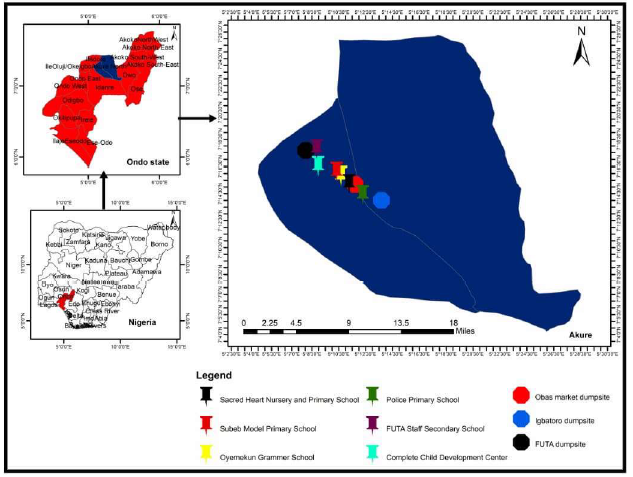
This study was conducted from May 2025 to October 2025 in Akure Metropolis, Ondo State, Southwestern Nigeria, within Akure South Local Government Area (LGA), located between Longitude 5°81 20.651”E and Latitude 7°18 18.481“N in the tropical rainforest zone (Fig. 1). The area experiences two distinct seasons: A rainy season from March to October and a dry season from November to February, with mean annual temperatures ranging from 21°C to 28°C. Based on the 2006 National Population Census, Akure South LGA had a population of 353,211, with an estimated annual growth rate of 3.03%13.
The study sites comprised six primary schools and three refuse dumpsites selected across residential and commercial areas of the study area. These locations were purposively selected to represent variations in waste composition, environmental conditions, and levels of human activity, factors that may influence the occurrence and spatial distribution of geohelminths.
|
Sample collection: Soil samples were collected from three distinct locations within each selected school: Playgrounds, general areas with minimal human activity, and toilet surroundings. At each location, soil samples were obtained using a sterile hand trowel at a depth of 3-5 cm. Individual samples were collected into clean, sterile polythene bags, properly sealed, and clearly labelled with relevant sampling details.
For dumpsite sampling, soil samples were obtained from three selected dumpsites. At each dumpsite, five soil samples were collected per visit from five spatially distinct points, and sampling was repeated on three separate occasions, yielding a total of 15 samples per dumpsite.
Sampling was conducted at a soil depth of 0-5 cm between 08:00 and 10:00 hours to minimize the impact of direct ultraviolet radiation and to maximize soil moisture retention, which favours parasite survival. At each sampling point, soil was excavated using clean, disinfected hand trowel and transferred into sterile polythene bags. All samples were appropriately labelled with site name, sampling point, and date of collection, following standard procedures as described by Babatunde et al.14. The collected samples were transported immediately to the laboratory and processed within 24 hours of collection to preserve the viability and integrity of helminth eggs and larvae prior to analysis.
Recovery of ova using the floatation technique: Five grams of soil were transferred into a sterile centrifuge tube and mixed with Sodium Chloride (NaCl) flotation solution (specific gravity 1.18) to approximately half the tube volume. The mixture was thoroughly agitated to disperse soil aggregates and release parasitic ova, then centrifuged at 1500 rpm for 5 minutes. After centrifugation, additional NaCl solution was added to create a convex meniscus, and a clean glass slide was placed over the tube for 3-5 minutes to allow floating ova to adhere. The prepared slide was subsequently examined using a compound microscope at ×10 and ×40 magnifications, and parasite ova were identified based on standard morphological keys provided15.
Recovery of larvae using the modified bearmann culture technique: The Modified Baermann technique16, was used to recover nematode larvae from soil samples. Twenty grams of soil were wrapped in muslin cloth and suspended in a funnel containing lukewarm saline for 72 hours to allow motile larvae to migrate into the attached tubing. The recovered suspension was transferred to a Petri dish, stained with eosin, and examined under a microscope (×4 and ×10 magnifications). Larvae were identified based on their motility, buccal cavity length, and tail morphology in accordance with the descriptions provided by Kumar et al.15.
Data analysis: Data from soil sample examinations were organized using Microsoft Excel (2013) and analysed with IBM SPSS Statistics version 22.0. Descriptive statistics (frequencies, percentages, and prevalence) were calculated, while inferential analyses included ANOVA with Duncan’s Multiple Range Test as a post-hoc test. The Chi-square test was used to compare public and private schools, sampling sites, and parasite species distribution, with statistical significance set at p<0.05.
RESULTS
A total of fifty-four soil samples were collected from six selected primary schools in Akure South Local Government Area. Of these, 48 samples (88.9%) tested positive for geohelminth contamination, while 6 (11.1%) were negative. Statistical analysis indicated no significant difference in contamination levels among the schools (p>0.05).
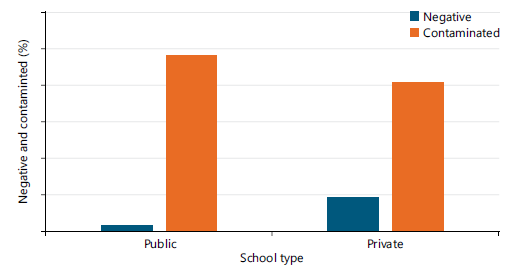
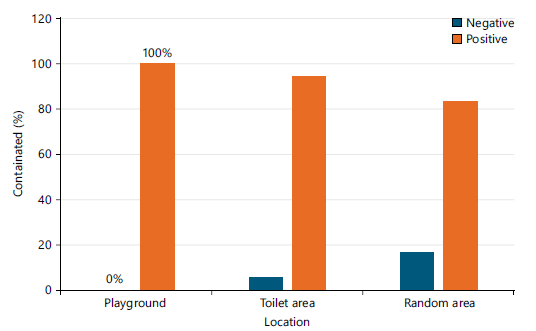
Comparison by school type revealed a higher prevalence of geohelminth contamination in soil samples from public schools (96.3%) compared to private schools (81.5%); however, this difference was not statistically significant (p>0.05) (Fig. 2). Based on sampling location, soil samples collected from playgrounds exhibited the highest contamination rate (100%), followed by those from toilet areas (94.4%), while samples from general areas showed the lowest prevalence (83.3%). Statistical analysis indicated that the observed differences among the three locations were not statistically significant (p>0.05) (Fig. 3).
|
|
| Table 1: | Prevalence of recovered larvae and ova from the study area | |||
| School name (%) | |||||||
| Parasite type | Complete | FUTA | Oyemekun | Police | Sacred heart | SUBEB | Total |
| Ascaris lumbricoides larva | 13.3 | 30 | 23.8 | 28 | 17.4 | 26.3 | 23.6 |
| Ascaris lumbricoides ova | 0 | 5 | 0 | 4 | 8.7 | 0 | 3.3 |
| Hookworm larva | 40 | 30 | 33.3 | 28 | 34.8 | 31.6 | 32.5 |
| Hookworm ova | 0 | 0 | 0 | 4 | 0 | 0 | 0.8 |
| Strongyloides stercoralis larva | 46.7 | 35 | 38.1 | 36 | 34.8 | 42.1 | 38.2 |
| Strongyloides steracoralis ova | 0 | 0 | 0 | 0 | 4.3 | 0 | 0.8 |
| Trichuris trichura ova | 0 | 0 | 4.8 | 0 | 0 | 0 | 0.8 |
| Total | 100 | 100 | 100 | 100 | 100 | 100 | 100 |
| χ2 = 19.912, df = 30, p = 0.919, FUTA: Federal University of Technology Akure and SUBEB: State Universal Basic Education Board | |||||||
|
| Table 2: | Percentage composition of soil-transmitted helminths across all dumpsites in the study area | |||
| Species | Number recovered | Percentage |
| Ascaris lumbricoides | 6 | 6.7 |
| Trichuris trichiura | 7 | 7.9 |
| Strongyloides stercoralis | 45 | 50.6 |
| Hookworm spp. | 28 | 31.5 |
| Bunostomum spp. | 3 | 3.4 |
| Total | 89 | 100 |
| χ2 = 74.09, df = 4 and p<0.001 | ||
| Table 3: | Mean separation of geohelminths identified in soil samples from the study sites | |||
| Species | FUTA dumpsite (Mean±SD) | Oja oba dumpsite (Mean±SD) | Igbatoro dumpsite (Mean±SD) |
| Ascaris lumbricoides | 0.33±0.58a | 1.67±0.58b | 0.00±0.00a |
| Trichuris trichiura | 1.00±1.00a | 0.00±0.00b | 1.33±1.53a |
| Strongyloides stercoralis | 3.00±1.73a | 6.33±0.58b | 5.33±2.08b |
| Hookworm spp. | 2.33±1.15a | 3.33±1.53b | 4.00±1.73b |
| Bunostomum spp. | 0.00±0.00a | 0.00±0.00a | 1.00±1.00b |
| Means followed by a similar alphabet along the same row indicate no significant difference (p>0.05) using New Duncan Multiple Range Test (DNMRT) | |||
The distribution of parasite larvae and ova recovered from soil samples was recorded (Table 1). The most prevalent were Strongyloides stercoralis larvae 38.2%, followed by hookworm larvae 32.5% and Ascaris lumbricoides larvae 23.6%. For ova Ascaris lumbricoides ova recorded 3.3%, hookworm 0.8%, Strongyloides stercoralis 0.8%, and Trichuris trichuris 0.8%. Statistical analysis revealed that there was no significant difference in parasite distribution among the schools (p>0.05).
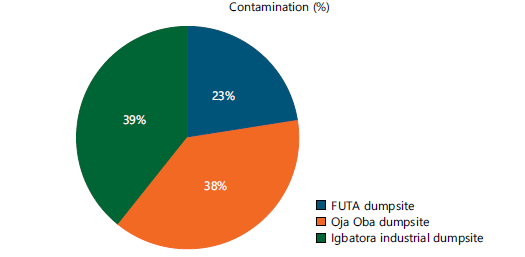
A total of Eighty-nine soil-transmitted helminths were recovered from the soil samples collected across the three selected dumpsites within Akure Metropolis. The distribution of the helminths across these dumpsites is presented in Fig. 4. Igbatoro recorded the highest number of parasites (35), representing 39.3% of the total, followed closely by Oja Oba with 34 helminths (38.2%). The FUTA dumpsite recorded the least with 20 helminths, which accounted for 22.5% of the overall total.
Strongyloides stercoralis alone accounted for more than half (50.6%) of all isolates, confirming its dominance in the study area. Hookworm species were the second most prevalent, making up 31.5% of all helminths detected. Other species were much less common: Trichuris trichiura (7.9%), Ascaris lumbricoides (6.7%), and Bunostomum spp. (3.4%). This distribution highlights that the helminth community in the dumpsites was heavily skewed towards Strongyloides and hookworms, with other species contributing only marginally.
In the Statistical analysis using Analysis of Variance (ANOVA) shown in Table 2, significant differences in helminth recovery across the different dumpsites was demonstrated.
Variation in helminth recovery across dumpsites was statistically significant (F = 3.90, p = 0.048), while species-wise differences were more pronounced (F = 7.94, p = 0.003). Strongyloides stercoralis consistently exhibited higher recovery, particularly at Oja Oba dumpsite (6.00-7.00), compared to FUTA (2.00-5.00) and Igbatoro (3.00-7.00). In contrast, Trichuris trichiura and Bunostomum spp. showed minimal or zero recovery across most sites. Duncan’s Multiple Range Test confirmed significant differences between selected sites and species (p<0.05) shown in Table 3.
DISCUSSION
The present study revealed a very high rate of geohelminth contamination within selected school environments, indicating that children are continuously exposed to infective stages through contact with contaminated soils. This finding is consistent with Oyewole and Simon-Oke17, who reported widespread soil contamination with Ascaris lumbricoides, hookworm, and Strongyloides stercoralis in Ondo State. The predominance of Strongyloides stercoralis further aligns with the report of Ekine and Oruloma18, who documented higher recovery of S. stercoralis larvae from school farm soils in Omelema, Rivers State, Nigeria.
The consistent detection of Ascaris lumbricoides across school environments highlights the persistent influence of poor sanitation and faecal contamination in maintaining transmission. Similarly, Simon-Oke and Oyewole9 reported widespread dispersal of A. lumbricoides ova in public spaces, attributing this to inadequate waste disposal practices. These comparable findings underscore that environmental contamination remains a major barrier to effective control, despite ongoing intervention efforts.
The relatively low recovery of Ascaris lumbricoides and Trichuris trichiura contrasts with their recognized global prevalence as major STHs19. This reduced detection may be attributed to local soil conditions, particularly aeration and moisture levels, which significantly influence egg survival and viability. Consistent with this, Simon-Oke and Oyewole9 reported that environmental factors strongly shape the spatial distribution of these parasites across sampling sites in Ondo State.
Although Bunostomum spp. occurred infrequently, its detection is noteworthy, as it indicates that open dumpsites can support a broad diversity of helminth species under conditions of indiscriminate waste disposal. Similarly, Siddiqua et al.20 demonstrated that heterogeneous waste environments provide favourable ecological niches that promote the persistence of less common parasites.
Igbatoro Industrial dumpsite recorded the highest prevalence (93.3%), whereas FUTA exhibited the lowest (66.7%). The elevated contamination at Igbatoro may be attributed to the combined disposal of industrial and household wastes, which creates favorable conditions for parasite survival. Similarly, the high prevalence observed at Oja Oba may be linked to intense market activities and the accumulation of organic waste that supports helminth persistence. In contrast, the comparatively lower prevalence at FUTA likely reflects more regulated waste management practices within an institutional environment. These observations are consistent with the findings of Oluwole et al.21, who reported that helminth distribution is strongly influenced by human activities and waste composition. Overall, the prevalence of 82.2% recorded in this study indicates a substantial level of soil contamination across Akure Metropolis.
CONCLUSION
This study demonstrates a high prevalence of geohelminth contamination in both school environments and dumpsites in Akure Metropolis, underscoring a significant public health concern. In schools, contamination is largely driven by poor sanitation, inadequate toilet facilities, poverty, and unhygienic practices, placing children at heightened risk of infection. Similarly, dumpsites were confirmed as major reservoirs of soil-transmitted helminths, with Strongyloides stercoralis and hookworm spp. predominating and the highest contamination recorded at the Igbatoro Industrial dumpsite. The widespread detection of helminths across all sites highlights the critical role of environmental contamination in sustaining transmission.
These findings emphasize the urgent need for integrated control strategies, including improved waste management systems, enhanced sanitation infrastructure, sustained hygiene education, and strict enforcement of environmental health policies. Strengthening hand hygiene practices in schools, ensuring access to clean water and sanitation facilities, and promoting community engagement are essential to interrupt transmission cycles and reduce the burden of geohelminth infections.
SIGNIFICANCE STATEMENT
Geohelminth infections continue to pose a serious public health challenge in many developing countries, particularly in areas with poor sanitation and waste management practices. This study highlights the high level of soil contamination with geohelminths in primary schools and dumpsites within Akure Metropolis, Ondo State, Nigeria. The findings demonstrate that school environments, especially playgrounds, serve as important reservoirs for soil-transmitted helminths, thereby increasing the risk of infection among school-aged children who frequently come into contact with contaminated soil. By identifying the distribution and prevalence of these parasites, this study provides important baseline data that can support public health interventions such as improved sanitation, proper waste disposal, routine deworming programs, and health education. Ultimately, the study contributes to efforts aimed at reducing the burden of soil-transmitted helminth infections and improving environmental and child health in endemic communities.
REFERENCES
- Riaz, M., N. Aslam, R. Zainab, Aziz-Ur-Rehman and G. Rasool et al., 2020. Prevalence, risk factors, challenges, and the currently available diagnostic tools for the determination of helminths infections in human. Eur. J. Inflammation, 20.
- Pullan, R.L., J.L. Smith, R. Jasrasaria and S.J. Brooker, 2014. Global numbers of infection and disease burden of soil transmitted helminth infections in 2010. Parasites Vectors, 7.
- Nxasana, N., K. Baba, V.G. Bhat and S.D. Vasaikar, 2013. Prevalence of intestinal parasites in primary school children of Mthatha, Eastern Cape Province, South Africa. Ann. Med. Health Sci. Res., 3: 511-516.
- Ezenwaka, C.O. and M.S. Okere, 2024. Occurrence of soil-transmitted helminths in selected waste dumpsites in Otuoke Community, Ogbia Local Government Area, Bayelsa State, Nigeria. Pan Afr. J. Life Sci., 8: 776-782.
- Chen, J., Y. Gong, Q. Chen, S. Li and Y. Zhou, 2024. Global burden of soil-transmitted helminth infections, 1990-2021. Infect. Dis. Poverty, 13.
- Karagiannis-Voules, D.A., P. Biedermann, U.F. Ekpo, A. Garba and E. Langer et al., 2015. Spatial and temporal distribution of soil-transmitted helminth infection in Sub-Saharan Africa: A systematic review and geostatistical meta-analysis. Lancet Infect. Dis., 15: 74-84.
- Pabalan, N., E. Singian, L. Tabangay, H. Jarjanazi, M.J. Boivin and A.E. Ezeamama, 2018. Soil-transmitted helminth infection, loss of education and cognitive impairment in school-aged children: A systematic review and meta-analysis. PLoS Negl. Trop. Dis., 12.
- Akeju, A.V., A.A. Olonisakin, T.A. Olusi and K.O. Oyebowale, 2025. Comparative recovery of soil-transmitted helminths using different diagnostic techniques in Akure South Local Government, Ondo State. J. Adv. Biol. Biotechnol., 28: 376-383.
- Simon-Oke, I.A. and O.E. Oyewole, 2022. Parasitic contamination of soil in private and public primary schools in Ifedore, Southwest, Nigeria. Infect. Dis. Trop. Med., 8.
- Imalele, E.E., E.E. Offiong, U.A. Ukam, A.W. Urimaneh and H.V. Utibe, 2021. Occurrence of soil-transmitted helminths from selected dumpsites and farmlands in Calabar, Nigeria. Annu. Res. Rev. Biol., 36: 14-22.
- Ojha, S.C., C. Jaide, N. Jinawath, P. Rotjanapan and P. Baral, 2014. Geohelminths: Public health significance. J. Infect. Dev. Countries, 8: 5-16.
- Tadesse, G., Y. Wuletaw, K. Mekete, H. Sime and E. Yard et al., 2024. Investigating the effect of a school-based WASH intervention on soil-transmitted helminth and schistosome infections and nutritional status of school children in Ethiopia: A quasi-experimental study. Parasites Vectors, 17.
- Obono, O. and E. Omoluabi, 2014. Technical and political aspects of the 2006 Nigerian population and housing census. Afr. Popul. Stud., 27: 249-262.
- Babatunde, O.S., I.A. Simon-Oke, I.I. Idowu, B. Adejoh and A.A. Olonisakin, 2025. Survey of refuse disposal practices, geohelminth contamination, and vector abundance at dumpsites in Akure Metropolis, Nigeria. J. Parasitol. Res., 2025.
- Kumar, S., S. Gupta, A. Mohmad, A. Fular, B.C. Parthasarathi and A.K. Chaubey, 2021. Molecular tools-advances, opportunities and prospects for the control of parasites of veterinary importance. Int. J. Trop. Insect Sci., 41: 33-42.
- Gelaye, W., N.A. Williams, S. Kepha, A. Messa Jr. and P.E. Fleitas et al., 2021. Performance evaluation of Baermann techniques: The quest for developing a microscopy reference standard for the diagnosis of Strongyloides stercoralis. PLoS Negl. Trop. Dis., 15.
- Oyewole, O.E. and I.A. Simon-Oke, 2022. Ecological risk factors of soil-transmitted helminths infections in Ifedore District, Southwest Nigeria. Bull. Natl. Res. Cent., 46.
- Ekine, E.G. and C.A. Orluoma, 2025. Assessment of soil transmitted helminths in soil ready for primary school farming activity in Omelema. Ife J. Sci., 26: 705-709.
- WHO, 2023. Soil-Transmitted Helminth Infections. World Health Organization, Geneva, Switzerland.
- Siddiqua, A., J.N. Hahladakis and W.A.K.A. Al-Attiya, 2022. An overview of the environmental pollution and health effects associated with waste landfilling and open dumping. Environ. Sci. Pollut. Res., 29: 58514-58536.
- Oluwole, A.S., U.F. Ekpo, D.A. Karagiannis-Voules, E.M. Abe and F.O. Olamiju et al., 2015. Bayesian geostatistical model-based estimates of soil-transmitted helminth infection in Nigeria, including annual deworming requirements. PLoS Negl. Trop. Dis., 9.
How to Cite this paper?
APA-7 Style
Simon-Oke, I. A., Omooye, D. O., Osanyintuyi, R. T., & Adeboyekun, S. E. (2026). Comparative survey of geohelminth parasites in soils of some schools and dumpsites in akure south metropolis, nigeria. Science International, 14(1), 61–69. https://doi.org/10.17311/sciintl.2026.61.69
ACS Style
Simon-Oke, I. A.; Omooye, D. O.; Osanyintuyi, R. T.; Adeboyekun, S. E. Comparative Survey of Geohelminth Parasites in Soils of Some Schools and Dumpsites in Akure South Metropolis, Nigeria. Sci. Int 2026, 14 (1), 61–69. https://doi.org/10.17311/sciintl.2026.61.69
AMA Style
Simon-Oke IA, Omooye DO, Osanyintuyi RT, Adeboyekun SE. Comparative survey of geohelminth parasites in soils of some schools and dumpsites in akure south metropolis, nigeria. Science International. 2026;14(1):61–69. doi:10.17311/sciintl.2026.61.69
Chicago/Turabian Style
Simon-Oke, I.A., D.O. Omooye, R.T. Osanyintuyi, and S.E. Adeboyekun. 2026. “Comparative Survey of Geohelminth Parasites in Soils of Some Schools and Dumpsites in Akure South Metropolis, Nigeria.” Science International 14 (1): 61–69. https://doi.org/10.17311/sciintl.2026.61.69

This work is licensed under a Creative Commons Attribution 4.0 International License.

