
Prevalence of Malaria and Hepatitis B Co-infection Among Patients Attending a Hospital in a Malaria-Endemic Region of Southwestern Nigeria
-
I.A. Simon-Oke
Parasitology and Public Health Unit, Department of Biology, Federal University of Technology, Akure, Nigeria
S.E. Adeboyekun
Parasitology and Public Health Unit, Department of Biology, Federal University of Technology, Akure, Nigeria
E.T. ObimakindeDepartment of Biological Sciences, Nigerian Defence Academy, Kaduna, Nigeria
| Received 21 Feb, 2026 |
Accepted 20 Jul, 2026 |
Published 30 Jul, 2026 |
Background and Objective: Malaria and hepatitis B remain highly prevalent infectious diseases in many developing nations, particularly in Nigeria, where they continue to pose significant public health challenges. This study evaluated the prevalence of malaria and hepatitis B Co-infection among patients visiting a health facility in Southwest region of Nigeria. Materials and Methods: A total number of two hundred and ten (210) patients visiting the BHC, Orita-Obele, Akure, Ondo State, Nigeria was enrolled during the study. Blood samples were obtained through venipuncture from all age group of patients and examined for malaria and hepatitis B infections using Malaria Plasmodium falciparum antigen detection kit (CareStartTM Malaria Pf [HRP2] Ag RDT) and HBV surface antigen Rapid Diagnostic Test kit (Prime rapid test kit) respectively. Demographic information of each patient was obtained and recorded while data obtained were analyzed to test for significance using Pearson’s Chi-Square at p = 0.05. Results: Of the total number 210 (male: 72, female: 138) patients examined for malaria and hepatitis B co-infection, 3 (1.4%) of the patients were tested to be co-infected with the two infections while equal prevalence (1.4%) of co-infection was a mong two sexes with no significant difference (p = 0.972). Prevalence of co-infection of malaria and hepatitis B was recorded among age groups 11-20, 31-40 and 51-60 only at varying degrees with no significance (p = 0.231). Also, there was no significant difference in the pattern of distribution of the two infections as regards the participants educational level (p = 0.839) and monthly income (p = 0.212). However, there was significance (p = 0.002) in the prevalence of co-infection of malaria and hepatitis B as regards the occupation of the participants with the farmers (25.0%) recording the highest prevalence. Conclusion: Presence of coexistence of malaria and hepatitis B infections among the studied population though at low prevalence will pose a serious public health problem in the study area if not properly managed. Therefore, there is a need for intervention to abate the spread of these diseases.
| Copyright © 2026 Simon-Oke et al. This is an open-access article distributed under the Creative Commons Attribution License, which permits unrestricted use, distribution, and reproduction in any medium, provided the original work is properly cited. |
INTRODUCTION
Malaria caused by Plasmodium species and infection with the Hepatitis B virus (HBV) remain widespread infectious diseases in many developing regions of the world1. According to the World Health Organization malaria fact sheet, approximately 241 million malaria cases and about 627,000 related deaths were reported globally in 20202. This figure reflects an increase of nearly 14 million cases when compared with the 2019 estimates, along with an additional 69,000 deaths. A substantial proportion of these deaths, about two-thirds, representing roughly 47,000 cases was attributed to interruptions in malaria prevention, diagnostic services, and treatment programs during the COVID-19 pandemic. Hepatitis B is a serious infectious disease that primarily affects the liver and is responsible for considerable morbidity and mortality worldwide. The infection is caused by the Hepatitis B virus, a partially double-stranded DNA virus classified within the Hepadnaviridae family3. Due to its widespread distribution and potential to cause chronic liver disease, HBV remains a major global health concern.
The HBV infection can result in a broad spectrum of clinical outcomes, ranging from acute hepatitis to long-term complications such as chronic hepatitis, liver cirrhosis, and hepatocellular carcinoma. Transmission occurs when individuals are exposed to infected blood or certain body fluids. The virus may be acquired during childbirth through mother-to-child transmission, as well as through contact with contaminated blood or exposure to infected sharp objects and instruments4. In 2015, the global prevalence of HBV infection in the general population was 3.5%. Among those born before the hepatitis B vaccine became available, the proportion of persons living with chronic HBV infection remains high. Prevalence was the highest in the African (6.1%) and Western Pacific regions (6.2%). Overall, about 257 million persons were living with HBV infection5. A major gap in hepatitis B prevention is the failure to administer the birth dose of the vaccine within 24 hours after delivery. This early dose is essential for protecting newborns, particularly those born to HBV-infected mothers, from vertical transmission. According to the World Health Organization, only about 43% of infants globally received the hepatitis B birth dose in 2019, indicating low early vaccination coverage6.
The World Health Organization (2019) reported that the disease was responsible for an estimated 820,000 deaths in 20197. However, a study revealed an estimated 3.6% of the global population is affected by chronic HBV infection8. In 2016, the World Health Organization (WHO) adopted the Global Health Sector Strategy on viral hepatitis, which set the goal of eliminating viral hepatitis as a public health problem by 2030, and specifically for 90% of infected persons to be diagnosed by 20309.
Nigeria is ranked as one of the countries that is hyper-endemic for HBV infection (>8%)10. Approximately nine in ten Nigerians who live with chronic HBV are unaware of their infection status, and are missing from the global public health statistics due to a lack of resources, awareness, and political will for addressing Nigeria’s HBV plight11. Consequently, Nigeria has one of the highest rates of HBV-attributable cancer in West Africa, with an age-standardized incidence estimate of 2.6 to <5.1 cases per 100,000 people12. This study aims to determine the prevalence and pattern of Malaria and Hepatitis B co-infection among patients visiting a selected hospital in a malaria-endemic region of Southwestern Nigeria.
MATERIALS AND METHODS
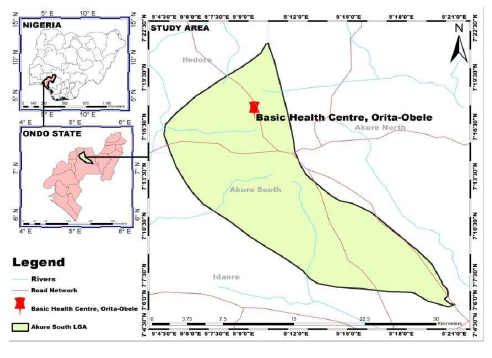
Study area and duration: The study was conducted over a period of 6 months, from November 2022 to April 2023, at the Basic Health Centre (BHC), Orita-Obele, located in Akure South Local Government Area (LGA), Ondo State, Nigeria. The BHC is situated at latitude 7°17'30.22"N and longitude 5°9'38.25"E, with an elevation of 390 meters above sea level. Akure South LGA lies within the rainforest zone, characterized by two main seasons: The rainy season (May-October) and the dry season (November-April). The environmental conditions of the area support the breeding of mosquito vectors, while most residents are primarily engaged in trading and commercial activities (Fig. 1).
|
Ethical clearance and informed consent: Prior to the commencement of the research, relevant approval was obtained from the Ethical review board of Ondo State Ministry of Health and consent was obtained from the medical officer in charge (OIC) of the Health Centre where samples were collected. Also, written informed consent was obtained from volunteers (who were clearly informed about the aims and objectives of the study) whose samples were used during the study.
Sample size determination: The sample size was determined using classical statistical method with the use of Raosoft sample size calculator at 5% margin of error and 95% confidence level13. A total number of two hundred and ten (210) patients visiting the BHC, Orita-Obele, Akure, Ondo State, Nigeria was examined during the study.
Data collection: With a well-structured questionnaire, demographic data and information such as age, sex, occupation, educational status, type of drug(s) used by patients and patients’ knowledge, attitude and practices towards malaria infection were obtained from patients who participated in the study.
Collection of blood samples: Blood samples were obtained through venipuncture from all age group of patients visiting the Basic Health Centre. With the use of sterile needle and syringe. Two to three milliliter of blood was aseptically collected from all age group of each patient by venipuncture after which the blood samples were dispensed into Ethylene-Diamine-Tetra-Acetic acid (EDTA) bottles to prevent coagulation of the blood sample. The sample bottles were labelled, and samples that were not analyzed on the same day of collection were kept in the refrigerator.
Blood sample analyses:
Malaria parasite analysis: Rapid Diagnostic Tests (RDTs) kits were used to screen the blood samples obtained from patients for malaria parasite. Malaria Plasmodium falciparum antigen detection kit (CareStartTM Malaria Pf [HRP2] Ag RDT) was used for diagnosis.
With the use of pipette in the kit, about 10 μL of blood was taken from the EDTA container and transferred into the sample well in the cassette. Three drops of buffer were added to the blood in the sample well after which it was left for some minutes and allowed to flow to the result window on the cassette. After 15 minutes, the cassette was then checked for the appearance of bands (control and the test bands) on the result window.
The test was interpreted to be positive with the appearance of bands in both control and test bands on the result window of the cassette while the test was interpreted to be negative with the appearance of only the control band on the result window of the cassette.
Hepatitis B virus analysis: Hepatitis B infection analysis was done HBV surface antigen Rapid Diagnostic Test kit (Prime rapid test kit). Which is specific and sensitive to Hepatitis B surface antigen. The test was carried out using the serum of each blood sample obtained from patients.
The EDTA bottles containing blood samples were left on a flat surface for about 20 minutes, after 20 minutes, the blood serum was seen to be separated from the whole blood. With the use of pipette, two drops of serum were picked from the EDTA bottle and placed on the test kit and then observed within 15 minutes as the result will be recorded as invalid after this period of time. Antibodies were detected from the serum of each test subject on the test strip. The test kits were carefully observed to check for indication of positivity or negativity reaction. The test results were interpreted to be positive with the appearance of bands both at the control region and test region of the kit while the test was interpreted to be negative with the appearance of a single band at the control region of the kit and non at the test region.
Data analysis
Statistical analysis: Prevalence refers to the proportion of a population affected by a specific condition or disease at a particular point in time14. In this study, prevalence was calculated using the following formula:
All data collected were subjected to Statistical Package for Social Sciences (SPSS) version 26 (IBM SPSS Statistics). Test for significance was done using Pearson’s Chi-Square, Phi and Cramer's V Tests at p = 0.05.
RESULTS
Of the total number 210 (male: 72, female: 138) patients examined for malaria and hepatitis B co-infection, 3 (1.4%) of the patients were tested to be co-infected with the two infections. The pattern of distribution of the two infections among the sexes revealed the same prevalence (1.4%) of co-infection among the male and the female cohorts. Statistical analysis showed that there was no significant difference (p>0.05) in the prevalence of co-infection among the sexes (Table 1).
| Table 1: | Prevalence of co-infection of malaria and hepatitis B among patients in relation to sexes | |||
| Sex | Number examined | Positive | Prevalence (%) |
| Male | 72 | 1 | 1.4 |
| Female | 138 | 2 | 1.4 |
| Total | 210 | 3 | 1.4 |
| χ2 = 1.001, df = 1, p = 0.972, phi = 0.002 and Cramer’s V = 0.002 | |||
| Table 2: | Prevalence of co-infection of malaria and hepatitis B among patients in relation to age group | |||
| Age group | Number examined | Positive | Prevalence (%) |
| 01-Oct | 22 | 0 | 0 |
| Nov-20 | 26 | 1 | 3.8 |
| 21-30 | 95 | 0 | 0 |
| 31-40 | 40 | 1 | 2.5 |
| 41-50 | 12 | 0 | 0 |
| 51-60 | 8 | 1 | 12.5 |
| 61-Above | 7 | 0 | 0 |
| Total | 210 | 3 | 1.4 |
| χ2 = 8.093, df = 6, p = 0.231, phi = 0.196 and Cramer’s V = 0.196 | |||
|
|
Result of this current study showed that the highest prevalence (12.5%) of co-infection of malaria and hepatitis B infections was recorded among patients within the age group of 51-60 years of age. However, it was observed that there was no case of co-infection of the two infections among patients within the age groups of 1-10 (0.0%), 21-30 (0.0%), 41-50 (0.0%) and 61 and above (0.0%) and no significant difference in the prevalence of co-infection of malaria and hepatitis B among the age groups (p>0.05) (Table 2).
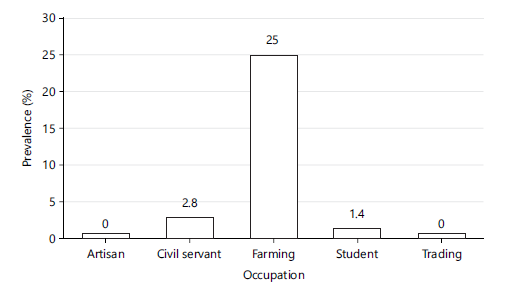
Among the different occupations, results showed a significant difference (p<0.05) in the prevalence of coinfection of malaria and hepatitis B among the patients (Fig. 2). It was observed that patients who engaged in farming (25.0%) shows the highest prevalence of co-infection while the Artisans (0.0%) and traders (0.0%) did no present any case of co-infection. There is significant difference in the prevalence of co-infection of malaria and hepatitis B in relation to the occupation of the patients
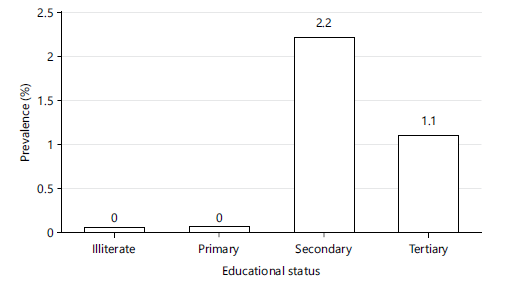
There exist no significant difference (p>0.05) in the prevalence of co-infection of Malaria and Hepatitis B in relation to educational status of the studied patients with patients who attained secondary level of education (2.2%) sharing the highest burden of co-infection of malaria and hepatitis B, followed by those who attained tertiary level of education (1.1%) while no case of co-infection was recorded among the illiterates (0.0%) and those that attained primary level of education (0.0%) (Fig. 3).
| Table 3: | Prevalence of co-infection of malaria and hepatitis B in relation to monthly income of patients | |||
| Monthly income | Number examined | Positive | Prevalence (%) |
| ≤ ₦18,000 | 59 | 0 | 0 |
| ₦19,000 - ₦49,000 | 70 | 2 | 2.9 |
| ≥ ₦50,000 | 49 | 0 | 0 |
| Total | 178 | 2 | 1.1 |
| χ2 = 3.121, df = 2, p = 0.212, phi = 0.132 and Cramer’s V = 0.132 | |||
Prevalence of co-infection of malaria and hepatitis B was observed to be influenced by the monthly income of participants in this study with those who earned between ₦19,000 - ₦ 49,000 monthly (2.9%) sharing the highest burden of co-infection while there was no case of co-infection among patients who earned less than N18,000 (0.0%) and those who earned above ₦ 50,000 (0.0%). There exist no significant difference in the prevalence of co-infection of malaria and hepatitis B in relation to the monthly income of the participants (p>0.05) (Table 3).
DISCUSSION
Results obtained from the investigation carried out on co-infection of malaria and hepatitis B among both in and outpatients visiting the BHC, Orita-Obele, Akure, revealed the existence of co-infection of the two infections among the studied population, though at very low prevalence. Co-existence of these two infections in the study area will continue to prose serious public health problem which calls for intervention. There are also reports of co-existence of malaria and hepatitis B in previous studies conducted in different regions of the country, though at varying prevalence15-18 which confirms that there is a need for serious public health intervention nationwide. Low prevalence of co-infection of malaria and hepatitis B recorded in this study is in line low prevalence of 1.9% in Port Harcourt Nigeria19. However, there were contrary reports of high prevalence of co-infection of the two infections in an urban region of Nigeria and Makurdi, Benue State, Nigeria15,20. Although there was low prevalence of co-infection recorded in this study, it is suggested that people should frequently carry out test on the two infections especially on hepatitis B infection because some of the infected patients could be chronic carriers of the infection who may not know they are infected21.
The results also revealed that both male and female participants shared an equal burden of malaria and hepatitis B co-infection. However, this outcome was not confirmed in both sexes of co-infection but higher prevalence of co-infection among males than females16,18,22. A higher prevalence of co-infection among females compared with the males was revealed in a study16. Equal prevalence of malaria and hepatitis B co-infection recorded among the sexes could be as a result of both genders is at equal exposure to the diseases17. Studies in Akure, Ondo State, Nigeria same town where this research was conducted previously, reported the occurrence of malaria and hepatitis B which both sexes could have been equally exposed to23,24.
As regards the age prevalence of co-infection of malaria and hepatitis B, it was observed that prevalence of the co-infection existed only among age groups 11-20, 31-40 and 51-60 though varying prevalence with the highest among age group 51-60 contrary to distribution among the different groups in Anambra State, Nigeria where they recorded 0% prevalence of co-existence of the two infections among age groups ≤20, 31-40 and 51-60 with other age groups recording varying prevalence17. Previous research revealed that hepatitis B infection varies depending on age25. Age groups where prevalence of the diseases was recorded in this study are known to be sexually active which supports transmission of hepatitis B virus26.
Also, most of the participants in the same age groups are of working-class age which could get exposed to malaria vector bites during their activities in their various works. These factors could have contributed to the coexistence of the two infections among these age groups.
The coexistence of malaria and hepatitis B infections in the different occupations engaged by the participants with those who engage in farming and civil service suffering the highest prevalence of infection confirmed the coexistence of the two infections among different occupational groups17. People in their different occupations could be highly exposed to malaria and hepatitis B infections but at a varying degree depending on the occupation. For instance, civil servants such as health workers, researchers and laboratory workers who handle human blood are at high risk of hepatitis B virus through their various work hazards.
Although, level of education helps to create proper awareness about how transmission of malaria and hepatitis B can be prevented17. The most worrisome case observed in this research was that the coexistence of the two infections was recorded among participants who attained secondary and tertiary level of education. It has been reported that sexual transmission of diseases such as hepatitis B is usually high regardless of the level of education17. This could have been responsible for the cases recorded among participants who attained secondary and tertiary level of education in this study.
Poverty is one of the influential factors that enhances disease transmission in a population. It was revealed in this study that people with low monthly income of ₦19,000-₦49,000 were more plagues with the coexistence of malaria and hepatitis B. This could be as a result of their inability to afford and access good health care facilities and shelter that could prevent them from exposure to infection.
CONCLUSION
There is coexistence of malaria and hepatitis B infections among the studied population, though at low prevalence, which has also been reported to exist by other researchers in different parts of the country. Owing to this fact, it is evident that these two infections are of public health problems nationwide, which calls for serious intervention to abate the spread of these diseases in the county. Therefore, the government must put in place proper and regular screening facilities to screen individuals for these infections. The Government should make vaccines accessible which can help to prevent people against Hepatitis B virus. Strong awareness on the effective means through which these diseases can be prevented should be carried out regularly in both rural and urban regions by public health workers. These will go a long way in curbing the spread on these infections in the country.
SIGNIFICANCE STATEMENT
Malaria and hepatitis B virus (HBV) infections are major public health challenges in Nigeria, and their coexistence may worsen clinical outcomes and complicate treatment. However, limited data exist on the prevalence of malaria-HBV co-infection in southwestern Nigeria. This study aimed to determine the prevalence and demographic distribution of malaria and hepatitis B co-infection among patients attending a primary healthcare facility in Akure, Ondo State. Blood samples from 210 patients were screened using rapid diagnostic tests, and data were analyzed using Pearson’s Chi-square test. The overall prevalence of co-infection was low (1.4%), with no significant associations observed with sex, age, education, or income. However, occupation was significantly associated, with farmers showing the highest prevalence (25.0%). Although low, the presence of co-infection represents a potential public health risk if poorly managed. These findings emphasize the need for integrated screening, targeted interventions, and strengthened public health strategies to reduce disease burden and improve healthcare outcomes in endemic regions.
REFERENCES
- Kotepui, K.U. and M. Kotepui, 2020. Prevalence of and risk factors for Plasmodium spp. co-infection with hepatitis B virus: A systematic review and meta-analysis Malar. J., 19.
- WHO, 2021. World Malaria Report 2021. World Health Organization, Geneva, Switzerland, ISBN: 9789240040496, Pages: 263.
- Ryu, W.S., 2017. Molecular Virology of Human Pathogenic Viruses. Academic Press, Amsterdam, Netherlands, ISBN: 978-0-12-800838-6, Pages: 423.
- Rajbhandari, R., V.H. Nguyen, A. Knoble, G. Fricker and R.T. Chung, 2025. Advances in the management of hepatitis B. BMJ, 389.
- WHO, 2017. Global Hepatitis Report, 2017. World Health Organization, Geneva, Switzerland, ISBN: 978-92-4-156545-5, Pages: 83.
- Khetsuriani, N., L. Mosina, P. van Damme, A. Mozalevskis, S. Datta and R.A. Tohme, 2021. Progress toward hepatitis B control—World Health Organization European Region, 2016-2019. Morbidity Mortality Wkly. Rep., 70: 1029-1035.
- Naghavi, M., W. Haidong, H.M. Jennifer, C. Magis-Rodriguez and A.A. Mahdi et al., 2015. Global, regional and national age-sex specific all-cause and cause-specific mortality for 240 causes of death, 1990-2013: A systematic analysis for the global burden of disease study 2013. Lancet, 385: 117-171.
- Sheena, B.S., L. Hiebert, H. Han, H. Ippolito and M. Abbasi-Kangevari et al., 2022. Global, regional, and national burden of hepatitis B, 1990-2019: A systematic analysis for the Global Burden of Disease Study 2019. Lancet Gastroenterol. Hepatol., 7: 796-829.
- Hutin, Y., D. Low-Beer, I. Bergeri, S. Hess and J.M. Garcia-Calleja et al., 2017. Viral hepatitis strategic information to achieve elimination by 2030: Key elements for HIV program managers. JMIR Public Health Surveillance, 3.
- Musa, B.M., S. Bussell, M.M. Borodo, A.A. Samaila and O.L. Femi, 2015. Prevalence of hepatitis B virus infection in Nigeria, 2000-2013: A systematic review and meta-analysis. Niger. J. Clin. Pract., 18: 163-172.
- Ajuwon, B.I., I. Yujuico, K. Roper, A. Richardson, M. Sheel and B.A. Lidbury, 2021. Hepatitis B virus infection in Nigeria: A systematic review and meta-analysis of data published between 2010 and 2019. BMC Infect. Dis., 21.
- de Martel, C., D. Georges, F. Bray, J. Ferlay and G.M. Clifford, 2020. Global burden of cancer attributable to infections in 2018: A worldwide incidence analysis. Lancet Global Health, 8: e180-e190.
- Oniya, M.O., E.T. Obimakinde, I.A. Simon-Oke, O.J. Afolabi, A.O. Adeogun and T.A. Oyeniyi, 2023. Prevalence of antimalaria-drug-resistant-Plasmodium-falciparum mutant genes in out-patients from a malaria endemic region in Southwest, Nigeria. Niger. J. Parasitol., 44: 21-36.
- Whiting, P.F., C. Davenport, C. Jameson, M. Burke, J.A.C. Sterne, C. Hyde and Y. Ben-Shlomo, 2015. How well do health professionals interpret diagnostic information? A systematic review. BMJ Open, 5.
- Aernan, P.T., T.T. Sar and S.H. Torkula, 2011. Prevalence of Plasmodia and hepatitis B virus co-infection in blood donors at Bishop Murray medical centre, Makurdi, Benue state, Nigeria. Asian Pac. J. Trop. Med., 4: 224-226.
- Dabo, N.T., A.A. Sharif, Y. Muhammed and F. Sarkinfada, 2015. Malaria and hepatitis B co-infection in patients with febrile illnesses attending general outpatient unit of the Murtala Muhammed Specialist Hospital, Kano, Northwest Nigeria. Bayero J. Pure Appl. Sci., 8: 89-95.
- Oparaku, N.F., E.S. Okwuonu, C.M. Eze, U.A. Ubaka and N.E. Ezenwaji et al., 2024. Co-infections of malaria and hepatitis B among pregnant women in Igbo-Eze North LGA of Enugu State, Nigeria. Niger. J. Parasitol., 45: 194-206.
- Abah, A.E. and I.N. Udoidang, 2019. Co-infection of malaria and hepatitis B virus in port Harcourt, rivers state, Nigeria. Int. J. Infect., 6.
- Wokem, G.N. and M.A. Amacree, 2018. Malaria and hepatitis-B co-infection in relation to selected haematological parameters among attendees of two health facilities in Port Harcourt, Nigeria. Int. J. Appl. Sci. Res. Rev., 5: 54-54.
- Adoga, M.P., S.D. Gyar, S. Pechulano, O.D. Bashayi and S.E. Emiasegen et al., 2010. Hepatitis B virus infections in apparently healthy urban Nigerians: Data from pre-vaccination tests. J. Infect. Dev. Countries, 4: 397-400.
- Omatola, C.A. and M.L.O. Okolo, 2021. Hepatitis B and asymptomatic malaria infection among pregnant women in a Semiurban Community of North-Central Nigeria. J. Environ. Public Health, 2021.
- Shapiro, C.N., 1993. Epidemiology of hepatitis B. Pediatr. Infect. Dis. J., 12: 433-437.
- Afolabi, O.J. and T.P. Bakare, 2022. Malaria, hepatitis B and their co-infection among pregnant women visiting maternity centers in Akure, Nigeria. Res. Square.
- Obimakinde, E.T. and I.A. Simon-Oke, 2017. The prevalence of malaria infection among patients attending the health centre of the Federal University of Technology, Akure, Nigeria. Int. J. Trop. Dis. Health, 27.
- Alikor, E.A. and O.N. Erhabor, 2007. Seroprevalence of hepatitis B surfact antigenaemia in childrean in a tertiary health institution in the Niger Delta of Nigeria. Niger. J. Med., 16: 250-251.
- Esan, A.J., C.T. Omisakin, T. Ojo-Bola, M.F. Owoseni and K.A. Fasakin, 2014. Sero-prevalence of hepatitis B and hepatitis C virue co-infection among pregnant women in Nigeria. J. Biomed. Res., 2: 11-15.
How to Cite this paper?
APA-7 Style
Simon-Oke,
I.A., Adeboyekun,
S.E., Obimakinde,
E.T. (2026). Prevalence of Malaria and Hepatitis B Co-infection Among Patients Attending a Hospital in a Malaria-Endemic Region of Southwestern Nigeria. Science International, 14(1), 70-78. https://doi.org/10.17311/sciintl.2026.70.78
ACS Style
Simon-Oke,
I.A.; Adeboyekun,
S.E.; Obimakinde,
E.T. Prevalence of Malaria and Hepatitis B Co-infection Among Patients Attending a Hospital in a Malaria-Endemic Region of Southwestern Nigeria. Sci. Int 2026, 14, 70-78. https://doi.org/10.17311/sciintl.2026.70.78
AMA Style
Simon-Oke
IA, Adeboyekun
SE, Obimakinde
ET. Prevalence of Malaria and Hepatitis B Co-infection Among Patients Attending a Hospital in a Malaria-Endemic Region of Southwestern Nigeria. Science International. 2026; 14(1): 70-78. https://doi.org/10.17311/sciintl.2026.70.78
Chicago/Turabian Style
Simon-Oke, I., A., S. E. Adeboyekun, and E. T. Obimakinde.
2026. "Prevalence of Malaria and Hepatitis B Co-infection Among Patients Attending a Hospital in a Malaria-Endemic Region of Southwestern Nigeria" Science International 14, no. 1: 70-78. https://doi.org/10.17311/sciintl.2026.70.78

This work is licensed under a Creative Commons Attribution 4.0 International License.
